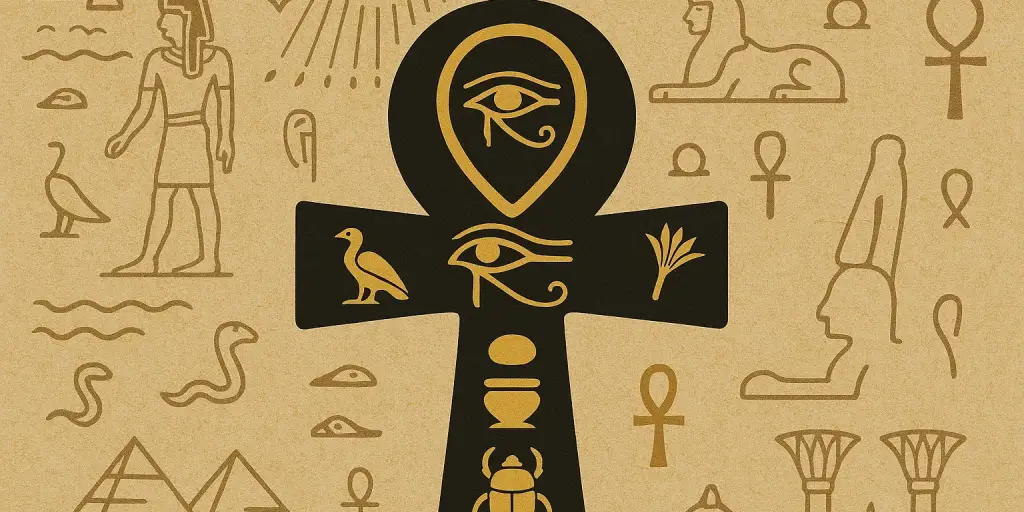
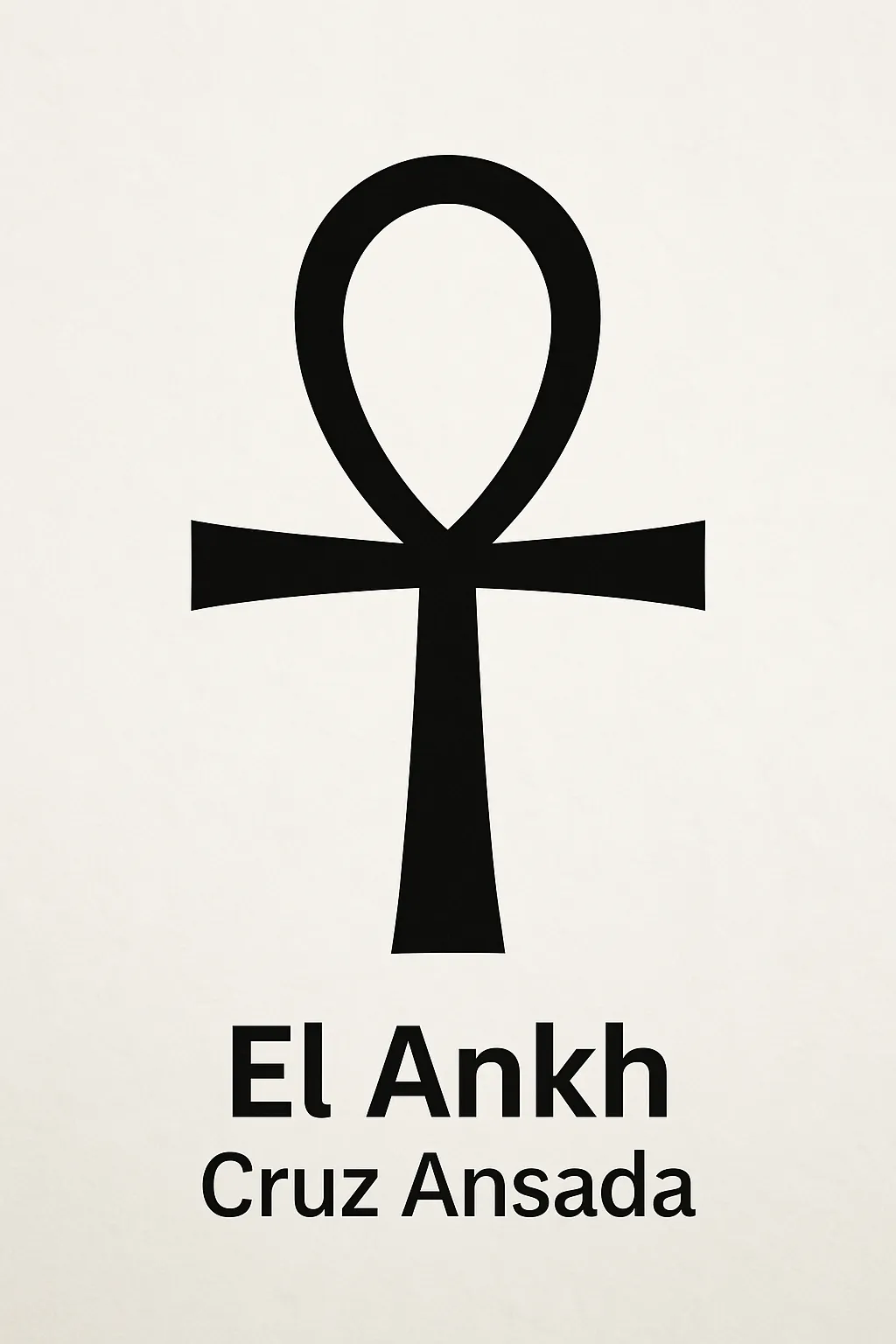
The Ankh, also known as the ansate cross or key of life, is one of the most iconic symbols of ancient Egypt. Its shape resembles a cross with an oval loop at the top, evoking both a key and a sandal strap. This hieroglyph means “life” and appears frequently in paintings, reliefs, amulets, jewelry, and temples throughout pharaonic history.
Its presence in Egyptian art is so constant that it has become an enduring emblem of this civilization’s legacy. From the earliest dynasties, the Ankh was a visual representation of the divine power to grant and sustain life.
Meaning of the Ankh in Egyptian Mythology
In Egyptian mythology, the Ankh symbolizes eternal life, creative power, and the immortality of the soul. Egyptian gods were often depicted holding the Ankh, indicating their ability to give or sustain life. Deities are frequently shown touching the Ankh to the pharaoh’s lips or nose, a gesture suggesting the transmission of the breath of life.
Originally, this gift of eternal life was reserved for pharaohs, who were seen as semi-divine beings. Over time, these beliefs became more democratic, and access to the afterlife became a common hope for all Egyptians who lived in accordance with the principles of maat, the cosmic order.
The Ankh is also associated with gods linked to death and resurrection, such as Osiris and Isis. Osiris, who dies and is resurrected, embodies the promise of a life beyond the earthly world, and the Ankh becomes the ultimate symbol of that transformation.
Use of the Ankh in Religious Practices, Tombs, and Art
The Ankh was not merely a symbolic sign; it was an integral part of Egyptians’ religious and artistic life. In rituals, gods and pharaohs appear holding the Ankh, or receiving its power in the form of streams of water shaped like the symbol.
In funerary art, the Ankh appears in scenes guaranteeing the deceased eternal life. In tombs, mummies, and sarcophagi, it was common to find Ankh-shaped amulets placed among the bandages or beside the body. These objects were meant to protect the soul and ensure its rebirth in the afterlife.
Many examples of jewelry, mirrors, and utensils shaped like the Ankh have also been found. Mirrors, in particular, were made in this silhouette not only for practical reasons but also because in Egyptian the word for “mirror” was the same as “life.” Thus, looking into a mirror was like contemplating the reflection of life itself.
The symbol was also frequently combined with other important signs, such as the djed pillar (stability) and the was scepter (power), creating triads that expressed wishes of life, strength, and stability for the bearer.
Parallels Between the Ankh and Symbols of Other Ancient Cultures
Although the Ankh is exclusive to the Egyptian tradition, its meaning has interesting parallels in other ancient cultures, which also developed symbols related to life, immortality, or connection with the divine.
The Christian Cross
The Christian cross, an emblem of faith in the afterlife through Christ’s sacrifice, has conceptual similarities with the Ankh. In Egypt, Coptic Christians adopted a modified version of the Ankh, known as the crux ansata, thus integrating an ancient symbol into the new Christian context. In both cases, the cross represents a victory over death and a promise of eternal life.
The Ouroboros
The Ouroboros, a serpent biting its own tail to form a circle, is another symbol deeply rooted in the idea of the eternal cycle. Used in ancient Egypt and later in alchemy and Greek philosophy, it represents regeneration, wholeness, and infinity. Like the Ankh, the Ouroboros conveys the idea that death is part of a continuous cycle of life, in an endless spiral.
The Tree of Life in Mesopotamia
In Mesopotamian cultures, the Tree of Life was a central figure in mythology. This sacred tree connected the celestial, earthly, and underworld realms, and granted fertility, wisdom, and eternal life. Kings were depicted touching this tree to receive its blessing, much like Egyptian pharaohs received the Ankh from the gods. Both symbols embody the idea of a divine source of life that grants order, longevity, and renewal.
The Enduring Importance of the Ankh
The Ankh is one of the most enduring and significant symbols of Egyptian iconography. It represented not only the abstract concept of life but also the tangible hope of eternal existence under the protection of the gods. Its constant presence in artifacts, rituals, and beliefs demonstrates the deep value Egyptians placed on life, not only in this world but beyond it.
Compared to other symbols from ancient cultures, the Ankh aligns with a universal human aspiration: to overcome death, connect with the sacred, and attain a life that does not fade with time. This cross with a loop at the top remains relevant today as a visual representation of the mystery and wonder of life.
Subscribe
If you want to receive stories, curiosities, and legends of the most fascinating creatures of classical mythology in your inbox, just fill out this form.
Continue reading
If you liked this article, you like mythology. And in this case, we have much more to offer you. Discover new adventures, heroes, nymphs, gods, battles, teachings… Just click on the button.
Egyptian Mythology in Hieroglyphs
Egyptian mythology is one of the most fascinating aspects of this ancient civilization. Historians and enthusiasts of antiquity have continually studied the gods and the stories surrounding these supernatural beings. One of the most intriguing ways this mythology was...
The Uraeus Serpent, Protector of the Pharaohs
In the vast and fascinating pantheon of Egyptian mythology, the Uraeus serpent holds a special place. More than a mythological creature, the Uraeus is a powerful symbol of protection, authority, and divinity. This article will explore the history and symbolism of the...
Khnum, the Creator God
In the vast pantheon of gods and goddesses of ancient Egyptian mythology, Khnum emerges as a divine figure of singular importance and intriguing symbolism. His role as the divine potter, creator of life, and guardian of the sources of the Nile marks him as one of the...

Satet, the Goddess of the Nile
Egyptian mythology, rich and complex, has fascinated humanity for millennia with its mysterious and powerful gods and goddesses. One of the lesser-known but equally important deities is Satet, the goddess of the Nile, of the flood, and of fertility. Despite her...

Kek, the God of Chaos
In the ancient mythological narratives of Egypt, one of the richest and most mysterious cultures in history, there is a deity who stands out for his peculiarity and complexity: Kek, the god of chaos and darkness. Although perhaps less well known than other Egyptian...

The Ennead, the 9 Gods of Egyptian Mythology
Egyptian mythology, with its profound narrative and its astonishing and enigmatic deities, has always captivated humanity. An intriguing element of this intricate belief system is the Ennead, a group of nine supreme deities who played a fundamental role in the...

Nephthys, Death and the Afterlife
In the vast and fascinating world of Egyptian mythology, the figure of Nephthys stands out with particular mystery. This goddess, often associated with death and the afterlife, is not as well known as other deities of her pantheon, but her stories and symbolism allow...

Apophis, the God of Chaos and Destruction
Throughout the centuries, the history of humanity has been fascinated by ancient myths and legends and their influence on contemporary culture. One such story is that of the Egyptian god Apophis, the god of chaos and destruction in Egyptian mythology. We are dealing...

Aten, the sun god
In the fascinating universe of Egyptian mythology, few figures spark as much interest as Aten, the solar deity who became the object of a monotheistic cult for a brief period in the history of ancient Egypt. His figure, linked to light and life, and his relationship...
mitologiaclasica.com is a website dedicated to exploring and popularizing the fascinating richness of mythology, offering a vast compendium of stories, characters, and legends.
Explore
Greek Mythology
Roman Mythology
Norse Mythology
Egyptian Mythology
Hindu Mythology
Chinese Mythology
Japanese Mythology
Celtic Mythology
Privacy Policy
Privacy Policy
Copyright mitologiaclasica.com