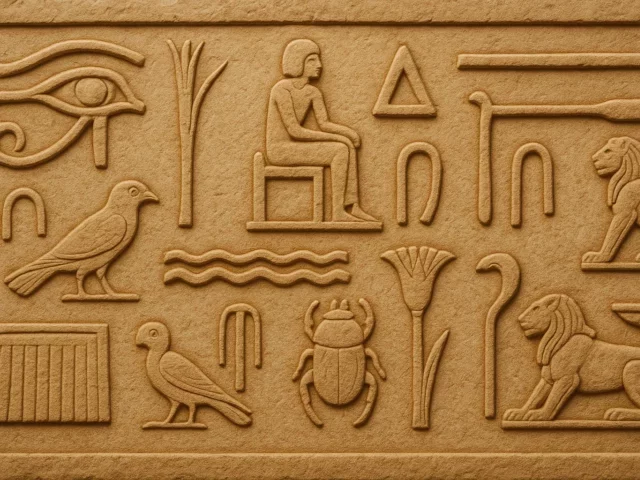
Egyptian mythology is one of the most fascinating aspects of this ancient civilization. Historians and enthusiasts of antiquity have continually studied the gods and the stories surrounding these supernatural beings. One of the most intriguing ways this mythology was expressed was through the use of hieroglyphs, a pictorial writing system that the ancient Egyptians used to record their religion, history, and culture. In this article, we will explore the role of hieroglyphs in Egyptian mythology.
Egyptian Mythology in Hieroglyphs
Hieroglyphs are a form of writing that originated in ancient Egypt. These pictorial symbols represented words or sounds and were used to record historical events, religious rituals, and myths. Egyptian mythology, rich and diverse, was one of the main areas that these hieroglyphs helped preserve for posterity. Hieroglyphs provide us with a unique view of how the ancient Egyptians saw the world and their place in it.
Egyptian mythology, with its numerous gods and goddesses, supernatural creatures, and tales of heroic deeds, was recorded in hieroglyphs on temple walls, monuments, and papyri. The Egyptians believed these hieroglyphs were sacred and possessed magical powers. Hieroglyphs were therefore not just a form of writing but also a form of worship and connection with the gods.
Hieroglyphs were used to tell stories about the gods, describe religious rituals, and record historical events related to religion and mythology. These painted or carved narratives not only provide a rich source of information about Egyptian mythology but also offer us insight into how the ancient Egyptians understood their world and their place in it.
Origin of Hieroglyphic Writing in Egypt
Hieroglyphic writing originated in Egypt around 3200 BCE, during the Predynastic Period. Hieroglyphs developed from a series of more primitive symbols used to represent common objects. Over time, these symbols evolved into a more complex and sophisticated form of writing.
The origin of hieroglyphs is closely linked to Egyptian religion and mythology. The earliest hieroglyphs were representations of gods and supernatural beings worshipped in ancient Egypt. Over time, these symbols came to represent words and sounds, allowing the Egyptians to record their stories and beliefs in a more detailed and precise way.
Hieroglyphs were used in a variety of contexts, from inscribing pharaohs’ names on monuments to describing rituals and myths on temple walls. Hieroglyphic writing became an integral part of Egyptian culture and played a crucial role in preserving its rich mythology.
Importance of Hieroglyphs in Egyptian Culture
Hieroglyphs played a crucial role in Egyptian culture. They were not only a form of communication but also a means of recording and preserving the religion, mythology, history, and traditions of ancient Egypt. Hieroglyphs were considered sacred and believed to possess magical powers.
Hieroglyphs were used in a variety of contexts, from inscribing pharaohs’ names on monuments to describing rituals and myths on temple walls. Hieroglyphic writing became an integral part of Egyptian culture and played a crucial role in preserving its rich mythology.
The Egyptians believed that hieroglyphs were the language of the gods, and that writing in hieroglyphs was a way of communicating with them. Hieroglyphs were therefore not just a form of writing but also a form of worship and connection with the gods.
Egyptian Mythology Depicted in Hieroglyphs
Hieroglyphs were the main way ancient Egyptians recorded and transmitted their mythology. Myths about gods and goddesses, tales of heroic deeds, descriptions of the afterlife, and religious rituals were carved in hieroglyphs on temple walls, monuments, and papyri.
Each god in Egyptian mythology had their own hieroglyph, usually a pictorial representation of the god or of the attributes associated with them. For example, the sun god Ra was commonly depicted as a falcon with a solar disk above its head, while the goddess Isis was associated with the hieroglyph of a throne.
In addition to representing the gods, hieroglyphs were also used to describe the myths and stories surrounding them. Through the interpretation of these hieroglyphs, scholars have been able to unravel many of the myths and legends of ancient Egyptian civilization.
The Voice of the Egyptian Gods
The Egyptians believed that hieroglyphs were the language of the gods. They thought that by writing them, they could communicate directly with the gods and receive their blessing or guidance. As a result, hieroglyphs were used in a range of religious contexts, from inscribing pharaohs’ names on monuments to describing rituals and myths on temple walls.
Hieroglyphs were also used in religious rituals to invoke the gods and ask for their help or protection. For example, during funerary rituals, hieroglyphs were used to invoke the gods of the underworld and ensure a safe journey for the deceased into the afterlife.
Hieroglyphs were seen as a form of magic and were believed to possess supernatural powers. The ancient Egyptians thought hieroglyphs could affect reality and could be used to cast spells or curses.
Decoding Hieroglyphs and Their Mysteries
Hieroglyphs remained a mystery to modern scholars until the discovery of the Rosetta Stone in 1799. The stone, which contained a royal decree written in three different scripts — hieroglyphic, demotic, and Greek — provided the key to unlocking the secrets of hieroglyphs.
Deciphering them was a long and complicated process that required the work of many scholars over several decades. The most significant achievement in this process was the work of the French scholar Jean-François Champollion, who in 1822 succeeded in translating hieroglyphs for the first time.
Since then, scholars have been able to translate thousands of hieroglyphic texts. This has allowed us to understand the mythology, religion, history, and culture of ancient Egypt much better. However, many mysteries surrounding Egyptian mythology have yet to be uncovered.
The Main Gods and Their Depiction
Gods and goddesses were an integral part of Egyptian mythology, and each had their own hieroglyph. These were pictorial representations of the gods or of the attributes associated with them.
For example, Ra, the sun god, was often depicted as a falcon with a solar disk above its head. Isis, goddess of magic and motherhood, was associated with the hieroglyph of a throne. Osiris, god of the underworld and resurrection, was often depicted as a mummified figure wearing an atef crown and holding a crossed crook and flail.
These hieroglyphs were not only a way of representing the gods but also provided information about their roles and attributes. Through the interpretation of these hieroglyphs, scholars have gained a deeper understanding of Egyptian mythology and of how the ancient Egyptians viewed their gods.
The Afterlife in Egypt
Belief in the afterlife was a central part of Egyptian religion and mythology. The Egyptians believed that after death, the soul of the deceased traveled to the Duat, or underworld, where it faced a series of trials before it could attain eternal life.
Hieroglyphs played a crucial role in these beliefs. Texts such as the Book of the Dead, filled with spells and rituals meant to help the deceased on their journey to the afterlife, were written in hieroglyphs.
Hieroglyphs were also used in tombs and sarcophagi to protect the deceased and guide them on their journey to the afterlife. It was believed that these magical symbols could repel evil spirits and help the deceased overcome the trials of the Duat.
The Role of Pharaohs in Hieroglyphic Egyptian Mythology
The pharaohs, or kings of Egypt, played an important role in Egyptian mythology. They were believed to be the embodiment of Horus, the sky god, and to serve as intermediaries between the gods and human beings.
Hieroglyphs were often used to record the names of pharaohs and the deeds they performed. Pharaohs’ names were often written in cartouches, oval-shaped hieroglyphic frames that symbolized divine protection.
Pharaohs also played a crucial role in religious rituals, which were often full of hieroglyphs. For example, during the coronation ceremony, the new pharaoh performed a series of rituals that were described and recorded in hieroglyphs.
A Window into Ancient Egypt
It is clear that hieroglyphs are an invaluable window into ancient Egypt. They provide us with valuable information about the religion, mythology, history, and culture of this ancient civilization. Through their interpretation, scholars have been able to unravel many of ancient Egypt’s mysteries.
They allow us to understand how the ancient Egyptians saw the world and their place in it. They give us a unique view of their beliefs, values, and way of life. Through hieroglyphs, we can better understand the gods and goddesses they worshipped, the myths and stories they told, and the practices and rituals they performed.
They also give us insight into daily life in ancient Egypt. They tell us about the lives of pharaohs, priests, and ordinary people. They show us how religion and mythology were woven into every aspect of Egyptian life.
The Legacy of Hieroglyphs in Egyptian Mythology
Hieroglyphs have left a lasting legacy in Egyptian mythology. Through them, the ancient Egyptians were able to record and preserve their myths, stories, and beliefs for posterity. Thanks to hieroglyphs, modern scholars have been able to unravel many of the mysteries of ancient Egyptian civilization.
They remain an invaluable source of information about Egyptian mythology. Many of the myths and stories that have survived to this day come from hieroglyphic texts. Without hieroglyphs, much of our understanding of Egyptian mythology would have been lost.
Although they fell out of use more than a thousand years ago, their impact on Egyptian mythology remains strong. Today, they continue to fascinate scholars and the general public alike, and their study remains an active field of research.
The Evolution of Hieroglyphic Writing Throughout History
Hieroglyphic writing underwent a series of changes and developments throughout its history. The earliest hieroglyphs were rudimentary pictorial representations of common objects. Over time, these symbols became more abstract and complex, and began to represent words and sounds rather than just objects.
Over the centuries, they became increasingly stylized and abstract. New forms of writing emerged, such as hieratic and demotic script, which were based on hieroglyphs but were simpler and easier to write.
Finally, with the arrival of Christianity in Egypt in the 4th century CE, their use began to decline. Nevertheless, hieroglyphs left a lasting legacy and continue to be an indispensable source of information about ancient Egyptian civilization.
Subscribe
If you want to receive stories, curiosities, and legends of the most fascinating creatures of classical mythology in your inbox, just fill out this form.
Continue reading
If you liked this article, you like mythology. And in this case, we have much more to offer you. Discover new adventures, heroes, nymphs, gods, battles, teachings… Just click on the button.
The Ankh Symbol: The Ansate Cross in Egyptian Mythology
The Ankh, also known as the ansate cross or key of life, is one of the most iconic symbols of ancient Egypt. Its shape resembles a cross with an oval loop at the top, evoking both a key and a sandal strap. This hieroglyph means “life” and appears frequently in...
The Uraeus Serpent, Protector of the Pharaohs
In the vast and fascinating pantheon of Egyptian mythology, the Uraeus serpent holds a special place. More than a mythological creature, the Uraeus is a powerful symbol of protection, authority, and divinity. This article will explore the history and symbolism of the...
Khnum, the Creator God
In the vast pantheon of gods and goddesses of ancient Egyptian mythology, Khnum emerges as a divine figure of singular importance and intriguing symbolism. His role as the divine potter, creator of life, and guardian of the sources of the Nile marks him as one of the...

Satet, the Goddess of the Nile
Egyptian mythology, rich and complex, has fascinated humanity for millennia with its mysterious and powerful gods and goddesses. One of the lesser-known but equally important deities is Satet, the goddess of the Nile, of the flood, and of fertility. Despite her...

Kek, the God of Chaos
In the ancient mythological narratives of Egypt, one of the richest and most mysterious cultures in history, there is a deity who stands out for his peculiarity and complexity: Kek, the god of chaos and darkness. Although perhaps less well known than other Egyptian...

The Ennead, the 9 Gods of Egyptian Mythology
Egyptian mythology, with its profound narrative and its astonishing and enigmatic deities, has always captivated humanity. An intriguing element of this intricate belief system is the Ennead, a group of nine supreme deities who played a fundamental role in the...

Nephthys, Death and the Afterlife
In the vast and fascinating world of Egyptian mythology, the figure of Nephthys stands out with particular mystery. This goddess, often associated with death and the afterlife, is not as well known as other deities of her pantheon, but her stories and symbolism allow...

Apophis, the God of Chaos and Destruction
Throughout the centuries, the history of humanity has been fascinated by ancient myths and legends and their influence on contemporary culture. One such story is that of the Egyptian god Apophis, the god of chaos and destruction in Egyptian mythology. We are dealing...

Aten, the sun god
In the fascinating universe of Egyptian mythology, few figures spark as much interest as Aten, the solar deity who became the object of a monotheistic cult for a brief period in the history of ancient Egypt. His figure, linked to light and life, and his relationship...

mitologiaclasica.com is a website dedicated to exploring and popularizing the fascinating richness of mythology, offering a vast compendium of stories, characters, and legends.
Explore
Greek Mythology
Roman Mythology
Norse Mythology
Egyptian Mythology
Hindu Mythology
Chinese Mythology
Japanese Mythology
Celtic Mythology
Privacy Policy
Privacy Policy
Copyright mitologiaclasica.com