In the vast pantheon of gods and goddesses of ancient Egyptian mythology, Khnum emerges as a divine figure of singular importance and intriguing symbolism. His role as the divine potter, creator of life, and guardian of the sources of the Nile marks him as one of the most venerated and worshipped deities in ancient Egypt. This article explores his many facets in depth, from his symbolic manifestations to his lasting influence on the culture and art of ancient Egypt and beyond.
The Creator God in Egyptian Mythology: Khnum
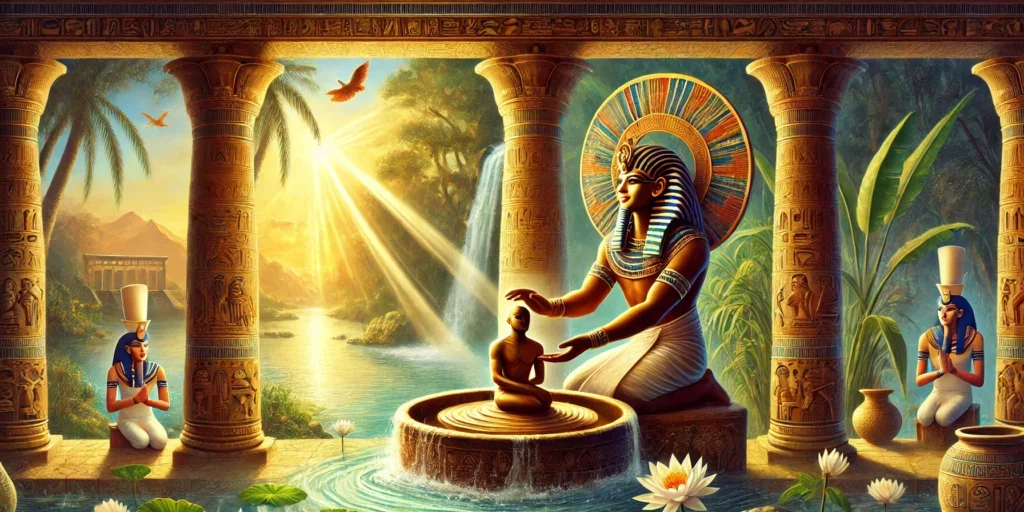
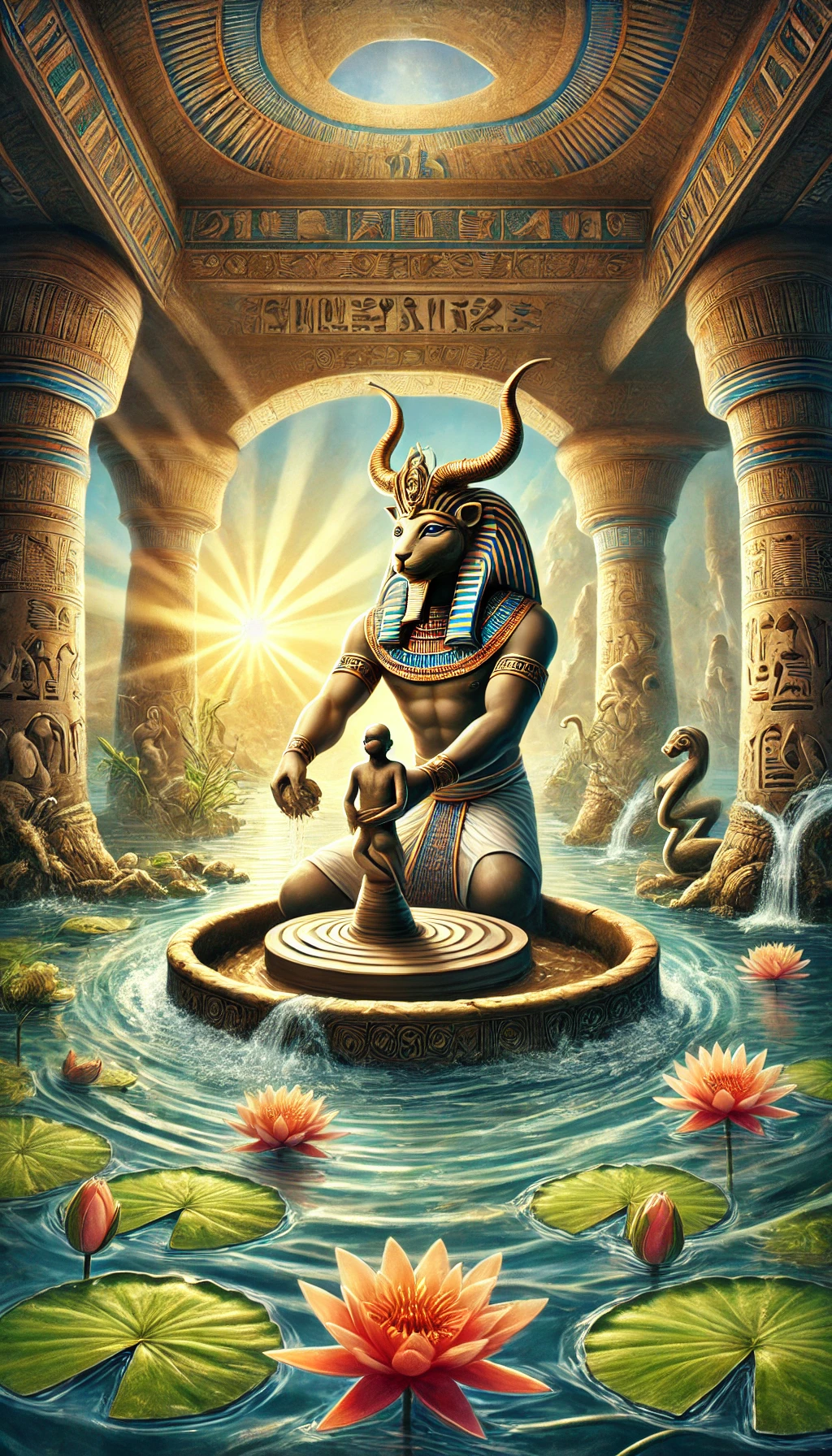
Khnum, also known as the “Creator God,” plays a crucial role in Egyptian mythology. He is credited with creating all living beings, shaping them on his potter’s wheel from the mud of the Nile. This act of divine creation is a recurring theme in Egyptian iconography, where Khnum is often depicted working at his wheel, shaping human life.
In ancient Egypt, the Nile was an essential life force, providing water and nutrients for the survival and growth of plants and animals. As creator god and guardian of the sources of the Nile, Khnum had the power to give life and sustain it, and was credited with controlling the floods, which were vital for agriculture and survival in ancient Egyptian civilization.
In addition to his role as creator god, he was also a deity of fertility, protector of life in general and of women in particular. He was believed to give the breath of life to newborns and to take part in the process of forming the child in the mother’s womb. This gave him a place of great importance in the conception and birth of life, and established him as an essential divine figure in Egyptian cosmogony.
His Role in the Egyptian Pantheon
Within the Egyptian pantheon, Khnum played a fundamental role. Although he did not belong to the main triad of gods that included Osiris, Isis, and Horus, his role as creator and giver of life placed him in a prominent position. He was part of the Elephantine Triad, a city located on Egypt’s southern border, together with the goddesses Satis and Anuket.
His role as guardian and controller of the waters of the Nile also made him essential to the survival and prosperity of Egyptian civilization. The Nile’s annual flood, which deposited fertile silt on farmland, was essential for agriculture. Khnum was therefore often worshipped and appeased with offerings and rituals to ensure a successful flood.
He was also considered the god of potters and was credited with creating the bodies of human beings on his potter’s wheel. This prominent role in the creation of life, along with his association with fertility and growth, established him as one of the most venerated and respected deities in ancient Egypt.
The Cult of Khnum: Temples and Worship
The cult of Khnum was centered on Elephantine Island, where his main temple was located. This was a site of great religious importance and is believed to have housed an important oracle. Many devotees traveled there to seek advice and blessings.
In addition to Elephantine, Khnum was also worshipped at other temples along the Nile, especially at Esna, where he was known as the “Lord of the Cataract,” reflecting his role as guardian of the sources of the Nile. At these sites, rituals and offerings were performed to secure his favor and protection.
His cult was not limited to temples alone. He was also honored in daily life through various practices and rituals. For example, potters asked for his blessing before beginning their work.
The Image of Khnum: Ram’s Head and Human Body
The god Khnum is traditionally depicted with the head of a ram and a human body, an iconography that reflects his role as creator god and provider of life. The ancient Egyptians associated the ram with fertility because of its ability to procreate quickly. In addition, his image as a man with a ram’s head underscored his authority and power, as well as his inextricable link with nature and life.
The Divine Potter: Creating Life on His Wheel
One of Khnum’s most distinctive traits was his role as the divine potter. According to the myths, he created humans and gods on his potter’s wheel, shaping their bodies from the mud of the Nile. This myth highlights the notion of life as a work of art, created with care and attention by a skillful god. It also underscores the importance of the Nile as a life source, since it is from its silt that Khnum creates life.
Khnum’s Family: Relationships with Other Gods
He was considered the husband of the goddess of fertility and motherhood, Heket, and father of the sky goddess, Nut. He also shared ties with other creator deities, such as Ptah and Atum. His close relationship with these gods underscores his central role in the myths of creation and fertility.
His Role in the Afterlife
Khnum’s role was not limited to this world. In the famous Book of the Dead, an Egyptian funerary text, he is credited with an important role in the afterlife. According to the text, Khnum was responsible for guiding souls through the underworld and giving them new life in the afterlife. This reinforces the notion of him as a god of life, but also as a god of transformation and rebirth.
The Myths of Khnum: Stories and Legends
Numerous myths and legends revolve around Khnum, illustrating both his power and his wisdom. In one of them, he creates humanity on his wheel, while in another, he saves Egypt from drought by controlling the waters of the Nile. These stories underscore his importance in Egyptian culture and the deep reverence the ancient Egyptians felt for this creator god.
The Rise and Decline of His Cult
The cult of Khnum was prominent in ancient Egypt, with temples dedicated to his worship in places such as Elephantine and Esna. Over time, however, his cult declined, in favor of deities such as Amun or Ra. Despite this, Khnum remained an important figure in Egyptian mythology, and his influence can be felt even today.
Influence on Art and Literature
Although the cult of Khnum has declined, his figure remains a source of inspiration in modern art and literature. From artistic depictions to novels and films, Khnum and his mythology have left an indelible mark on contemporary culture. His story continues to fascinate, and his iconography, with its unmistakable ram’s head, remains a powerful symbol of creativity and life.
Contemporary Interpretations of Creation
The figure of Khnum has also found resonance in modern science. Some scientists have interpreted the legend of Khnum creating life on his wheel as a metaphor for the process of cell division, with Khnum as the master potter directing the formation of new beings. This interpretation highlights the enduring relevance of myths and how they can serve to illustrate complex scientific concepts.
In short, Khnum, with his ram’s head and potter’s wheel, is one of the most fascinating and significant figures in Egyptian mythology. His role as god of fertility and creator of life, his presence in modern art and literature, and his legacy in the contemporary interpretation of creation make Khnum an essential deity for understanding the rich and complex mythology of ancient Egypt.
Subscribe
If you want to receive stories, curiosities, and legends of the most fascinating creatures of classical mythology in your inbox, just fill out this form.
Continue reading
If you liked this article, you like mythology. And in this case, we have much more to offer you. Discover new adventures, heroes, nymphs, gods, battles, teachings… Just click on the button.
Egyptian Mythology in Hieroglyphs
Egyptian mythology is one of the most fascinating aspects of this ancient civilization. Historians and enthusiasts of antiquity have continually studied the gods and the stories surrounding these supernatural beings. One of the most intriguing ways this mythology was...
The Ankh Symbol: The Ansate Cross in Egyptian Mythology
The Ankh, also known as the ansate cross or key of life, is one of the most iconic symbols of ancient Egypt. Its shape resembles a cross with an oval loop at the top, evoking both a key and a sandal strap. This hieroglyph means “life” and appears frequently in...
The Uraeus Serpent, Protector of the Pharaohs
In the vast and fascinating pantheon of Egyptian mythology, the Uraeus serpent holds a special place. More than a mythological creature, the Uraeus is a powerful symbol of protection, authority, and divinity. This article will explore the history and symbolism of the...

Satet, the Goddess of the Nile
Egyptian mythology, rich and complex, has fascinated humanity for millennia with its mysterious and powerful gods and goddesses. One of the lesser-known but equally important deities is Satet, the goddess of the Nile, of the flood, and of fertility. Despite her...

Kek, the God of Chaos
In the ancient mythological narratives of Egypt, one of the richest and most mysterious cultures in history, there is a deity who stands out for his peculiarity and complexity: Kek, the god of chaos and darkness. Although perhaps less well known than other Egyptian...

The Ennead, the 9 Gods of Egyptian Mythology
Egyptian mythology, with its profound narrative and its astonishing and enigmatic deities, has always captivated humanity. An intriguing element of this intricate belief system is the Ennead, a group of nine supreme deities who played a fundamental role in the...

Nephthys, Death and the Afterlife
In the vast and fascinating world of Egyptian mythology, the figure of Nephthys stands out with particular mystery. This goddess, often associated with death and the afterlife, is not as well known as other deities of her pantheon, but her stories and symbolism allow...

Apophis, the God of Chaos and Destruction
Throughout the centuries, the history of humanity has been fascinated by ancient myths and legends and their influence on contemporary culture. One such story is that of the Egyptian god Apophis, the god of chaos and destruction in Egyptian mythology. We are dealing...

Aten, the sun god
In the fascinating universe of Egyptian mythology, few figures spark as much interest as Aten, the solar deity who became the object of a monotheistic cult for a brief period in the history of ancient Egypt. His figure, linked to light and life, and his relationship...

mitologiaclasica.com is a website dedicated to exploring and popularizing the fascinating richness of mythology, offering a vast compendium of stories, characters, and legends.
Explore
Greek Mythology
Roman Mythology
Norse Mythology
Egyptian Mythology
Hindu Mythology
Chinese Mythology
Japanese Mythology
Celtic Mythology
Privacy Policy
Privacy Policy
Copyright mitologiaclasica.com