The Rainbow Goddess in Greek Mythology
In Greek mythology, Iris is the goddess of the rainbow and the messenger of the gods. This winged goddess is famous for her speed and her loyalty to the gods of Olympus. She is a fascinating figure, serving as a bridge between heaven and earth, carrying messages from the gods to humans and from humans to the gods.
She was associated with communication, truth, and promises, and was believed to have the ability to travel with the speed of the wind from one place to another. She was a peace-bringing goddess, carrying messages from the gods to humans.
In iconography, she is often depicted as a young woman with wings, carrying a caduceus or a water jug. The rainbow, believed to be her path as she traveled through the sky, is her main symbol and is associated with hope and promise.
Origin and History of Iris in Ancient Greek Beliefs
According to tradition, Iris was born of the sea gods Thaumas and Electra. Although she is not one of the Olympian goddesses, she is frequently mentioned in classical texts, and her presence is felt in many stories and legends.
She is one of the few goddesses of ancient Greece who has not been replaced or absorbed by other deities in Roman mythology. Despite not being as well known as some other mythological figures, she played a crucial role as messenger of the gods and as a symbol of the link between heaven and earth.
Who Were Her Parents and Siblings?
Iris is said to have been the daughter of Thaumas, the sea god, and Electra, an ocean nymph. According to the myths, Thaumas and Electra had several daughters, all associated with aquatic phenomena. Iris’s sisters were the Harpies, creatures with bird bodies and women’s faces, known as spirits of violent, stormy wind.
On the other hand, she is said to have been married to Zephyrus, the god of the west wind. Together, they had a son named Pothos, who symbolizes desire. Thus, Iris’s family was intimately linked to the natural elements, such as the sea, the wind, and desire.
She also had a sister named Arce, who became the messenger of the Titans during the Titanomachy, the war between the Titan and Olympian gods. This adds an element of conflict and duality to Iris’s family, since while Iris served the Olympian gods, her sister served their enemies.
Iris’s Role in Greek Stories and Legends
As messenger of the gods, she is often mentioned carrying important messages or announcing significant events. For example, in Homer’s Iliad, she carries messages from Zeus to mortals and to other gods.
Moreover, she also played a role in the myth of the rescue by Perseus. When he was sent to kill Medusa, Iris provided him with the cloak of invisibility that allowed him to complete his task unseen.
Another important story in which Iris plays a role is that of the Trojan War. Iris was sent by Zeus to deliver a message to the Trojans, warning them of the arrival of the Greek warrior Achilles.
Her Connection with the Other Gods of Olympus
Although Iris is not an Olympian deity, she has a strong connection with the gods of Olympus due to her role as messenger. Her loyalty and service to the gods are well known, and she is respected for her speed and efficiency in delivering messages.
Iris is particularly associated with Zeus and Hera, whom she served most frequently. Zeus is said to have trusted her for her speed and her ability to travel between heaven and earth.
Similarly, Hera, Zeus’s wife and queen of Olympus, also trusted her to carry her messages. In many ways, she was the link between the gods of Olympus and humans on earth.
How Was She Depicted in Greek Art and Literature?
In Greek art and literature, Iris is often depicted as a young, beautiful woman with bird wings. She carries a caduceus, the winged staff of Hermes, which is a symbol of her role as messenger.
In some depictions, Iris is shown flying through the sky, leaving a trail of rainbow in her wake. This image underscores her role as a link between heaven and earth and her association with communication and promise.
In literature, she is mentioned in the texts of Homer, such as the Iliad and the Odyssey. In these tales, she is portrayed as an efficient and swift messenger, carrying messages from the gods to humans and vice versa.
The Rainbow: A Divine Symbol in Greek Mythology
The rainbow is the most famous symbol associated with Iris. In Greek mythology, the rainbow was believed to be the path Iris used to travel from heaven to earth. This symbol represents the connection between the divine realm and the mortal world, and is also associated with communication and promises. According to legend, when a rainbow appeared in the sky, it was understood as a sign that Iris was delivering a message from the gods.
It also symbolizes hope and the promise of better times. When a rainbow is seen after a storm, it is considered a sign of Iris’s promise that the storm has ended and that better times are coming.
Her Relationship with Mortals in Greek Myths
As we have mentioned, Iris had a unique relationship with mortals in Greek mythology. As messenger of the gods, she often communicated directly with humans, carrying divine messages to them.
Despite her role as messenger, she was not a figure feared by humans. On the contrary, she was appreciated for her role in communication between gods and humans. Mortals trusted her to carry their prayers and offerings to the gods of Olympus.
Iris’s Function in the Epic Stories of Greek Mythology
The goddess Iris appears in several epic stories of Greek mythology, as a divine messenger who conveys messages between gods and mortals. Her best-known depiction is in Homer’s “Iliad,” where she is described as the messenger of the gods and especially of Hera, queen of the gods. In these stories, Iris is seen as a symbol of communication and connection between the divine and human worlds.
In addition to her role as messenger, Iris also performs crucial functions in other myths. For example, in the “Odyssey,” she is the one who wakes the sleeping Odysseus to warn him of danger. In other stories, she is credited with the task of carrying water from the river Styx to the gods, whose oath upon this water is unbreakable and sacred.
Finally, she is also associated with guiding the souls of women to the underworld. In this role, she assumes a function similar to that of the god Hermes, who guides the souls of men into the afterlife.
Comparing Iris to Other Greek and Roman Goddesses
Unlike other Greek goddesses who are often associated with specific aspects of life and culture, such as wisdom, love, or war, Iris represents a natural element, the rainbow. As such, she personifies the connection between heaven and earth, and her role as messenger between gods and mortals further emphasizes this connection.
She also differs from other goddesses in that she has no direct equivalent in Roman mythology. Although the Roman goddess Juno is sometimes associated with Iris’s functions, there is no Roman figure that directly corresponds to her. This perhaps suggests that the function of divine messenger and link between heaven and earth is distinctly Greek.
Moreover, Iris is distinguished from other goddesses by her apolitical nature. Unlike goddesses such as Athena or Aphrodite, who are often at the center of conflicts and confrontations, Iris is rarely involved in such situations. Her role is limited mainly to conveying messages and carrying out tasks for other gods, which places her on a different plane from many of her divine counterparts.
Influence on Contemporary Greek Culture and Society
Despite being less recognized compared to other goddesses, Iris has a notable influence on contemporary Greek culture and society. Her figure has often been associated with communication and connection, two aspects that remain fundamental in modern society.
In contemporary Greece, the name Iris is frequently used for girls, reflecting continued reverence for this ancient goddess. Moreover, her image has been used in a variety of artistic and cultural contexts, from literature and poetry to painting and sculpture.
Iris’s influence can also be seen in modern science. The term “iris” is used in anatomy to describe the part of the human eye that controls the dilation and contraction of the pupil, a tribute to the goddess who connected heaven and earth.
Relevance in Greek Mythology Today
While Greek mythology has greatly influenced contemporary culture, the figure of Iris retains a special relevance. Through her role as messenger between gods and mortals, Iris personifies communication and connection, two aspects of vital importance in the modern world.
Despite being less recognized compared to goddesses such as Aphrodite or Athena, her influence has remained constant throughout the centuries. Today, Iris remains a symbol of communication and connection, and her figure remains relevant in contemporary culture and society.
Not the Best Known, But Highly Relevant
In conclusion, although Iris may not be the best-known goddess in Greek mythology, her role and influence make her a fascinating and relevant figure who deserves to be recognized and celebrated.
It is true that Greek mythology has left an indelible mark on our culture and society, and the figure of Iris is a perfect example of this lasting influence. Through her role as divine messenger, Iris has left her mark on literature, art, and culture, and her influence can be felt in contemporary Greek society. Although her figure may be less well known than that of other deities, Iris remains a relevant figure in Greek mythology, and her influence will endure in the years to come.

Subscribe
If you want to receive in your mailbox stories, curiosities and legends of the most fascinating creatures of classical mythology just fill in this form.
Continue reading
If you liked this article, you like mythology. And in this case, we have much more to offer you. Discover new adventures, heroes, nymphs, gods, battles, teachings… Just click on the button.

Deimos, the God of Terror
If we venture into the fascinating universe of Greek mythology, we find Deimos, one of the least explored deities but with undeniable relevance. Deimos, whose name means "dread," is an enigmatic god linked to the darkest and most frightening aspects of human...
Tiresias, the Blind Prophet
One of the most intriguing and multifaceted characters in Greek mythology is Tiresias, the blind prophet of Thebes. This seer, who spent seven years as a woman before becoming a man again, plays a fundamental role in several literary works, including tragedies by...
The Sacrifice of Iphigenia
Greek mythology is full of heroes, gods, and complex characters, each with their own stories and lessons. One of these figures, perhaps somewhat less well known, is Iphigenia, the unfortunate daughter of Agamemnon and Clytemnestra. Although her story is tragic, her...
Erysichthon, Insatiable Hunger
The ancient stories of Greek mythology have fascinated humanity for thousands of years. Their narratives, full of gods, heroes, mythical creatures, and moral lessons, have influenced many cultures and remain relevant to this day. In this article, we will focus on one...
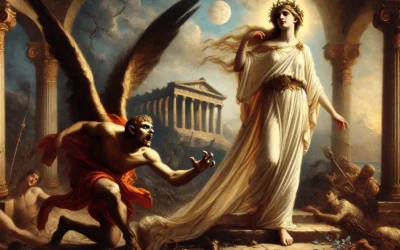
The Myth of Philomela and Procne
Today we discuss the myth of Philomela and Procne. It is a tragic and moving story from ancient Greek mythology, notable both for the rawness of its details and for its powerful symbolism. It is the story of two sisters, bound by unbreakable ties of loyalty and love,...

Leda and the Swan
Greek mythology is full of astonishing stories that have left an indelible mark on culture and art over the centuries. One of the most intriguing and controversial tales is that of "Leda and the Swan." The story of the seduction of the mortal Leda by the god Zeus...

Who Was the Goddess Atalanta?
Atalanta, an iconic figure in Greek mythology, is famous for her tireless speed and sharp wit. In a world dominated by men, she emerged as a heroine, defying conventional norms and forging her own path. In every tale about her life, her resilience and her ability to...
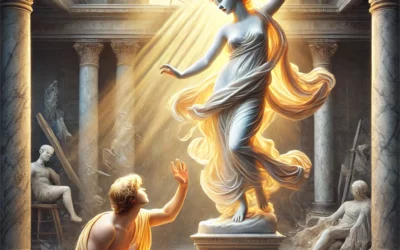
What Is the Story of Pygmalion and Galatea?
The names Pygmalion and Galatea resonate in the collective imagination. They are two figures who have inspired poets, writers, and artists throughout the centuries. The love story between the sculptor and his creation is one of the most moving and fascinating in Greek...

Nereus, the Old God of the Sea
Greek mythology is a vast mosaic of gods, heroes, and legendary entities, each with its own narrative and singular character. One of these gods is Nereus, an ancient sea deity who, although less well known than Poseidon, plays an important role in the Greek pantheon....

mitologiaclasica.com is a website dedicated to explore and spread the fascinating richness of mythology, offering a vast compendium of stories, characters and legends.
Explore
Greek Mythology
Roman Mythology
Norse Mythology
Egyptian Mythology
Hindu Mythology
Chinese Mythology
Japanese Mythology
Celtic Mythology
Privacy Policy
Privacy Policy
Copyright mitologiaclasica.com