Roman antiquity is full of myths and legends. One of the most fascinating and enigmatic figures of the period is Janus, the two-faced god. This god, who is both familiar and puzzling, has been the subject of countless debates and analyses over the centuries. This article will delve into the history and symbolism of this Roman god, and explore how his legacy has survived to this day.
Which God Has Two Faces?
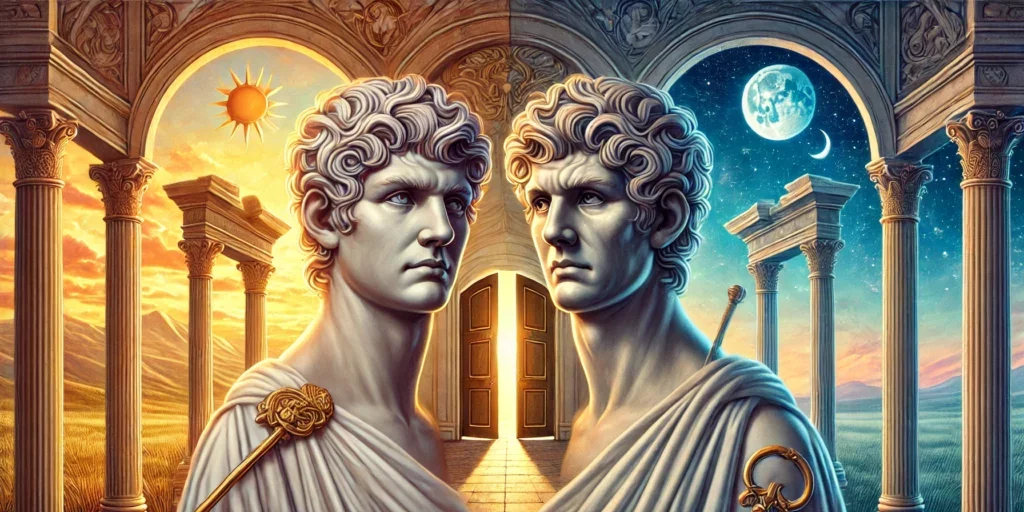
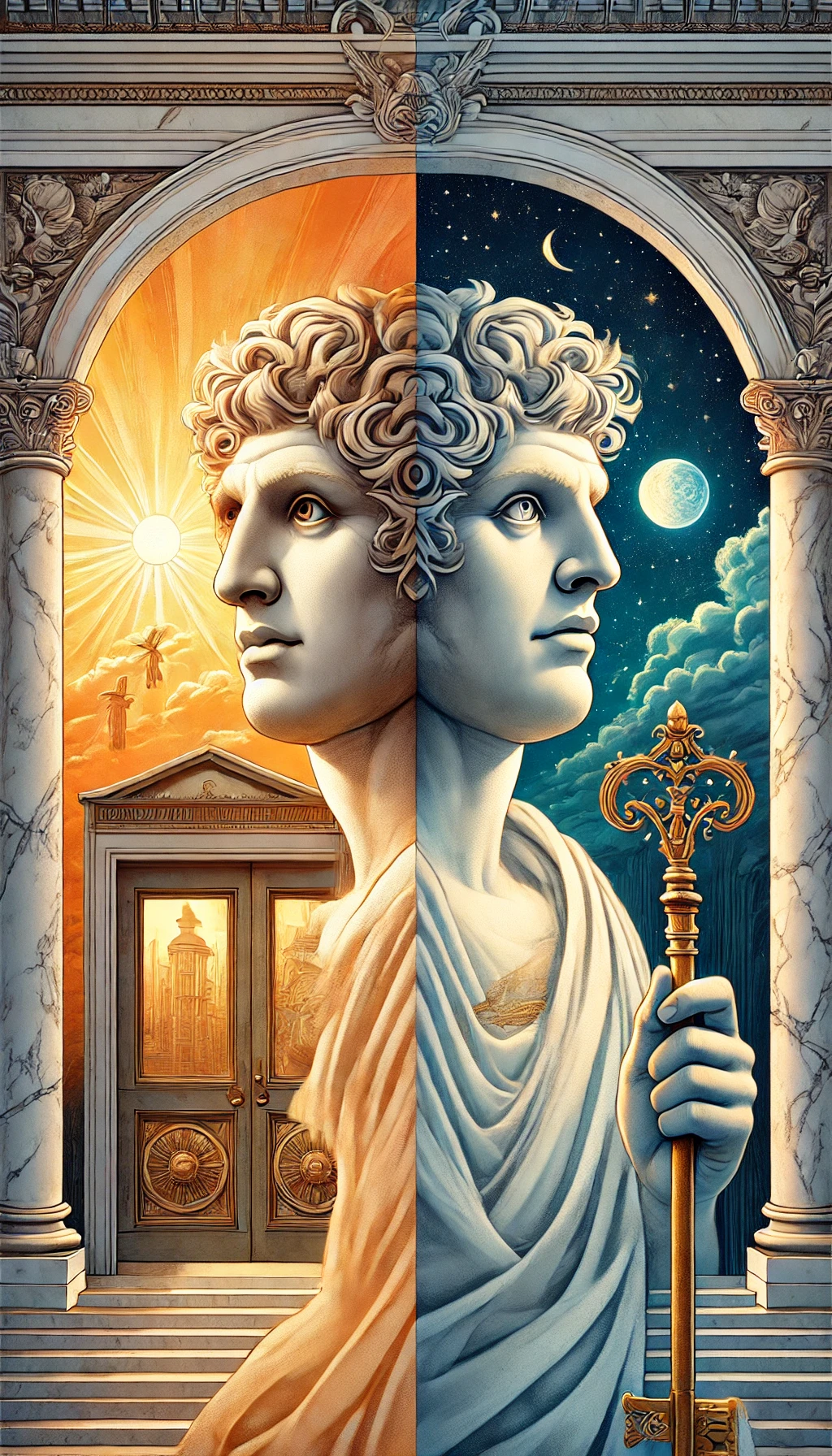
Janus is a unique deity within Roman mythology. He is famous for his distinctive appearance with two faces, one looking forward and the other backward. This peculiar feature not only sets him apart from other deities, but also reflects his domain and functions.
He is the god of beginnings and endings, transitions and passages, portals and doorways. His two faces symbolize the duality of these aspects, watching both the future and the past, and keeping an eye on each end of the temporal spectrum.
Who Was Janus in Roman Mythology?
We are talking about one of the oldest deities in the Roman pantheon, considered a primordial deity. Although he is not associated with a direct Greek equivalent, some sources suggest he could be related to the Greek god Hermes, the messenger of the gods and patron of borders and travelers.
Although he is not frequently mentioned in Roman myths, Janus is an omnipresent figure in the daily life of the Romans. He was honored at the start of each day, month, and year. He was invoked at the beginning of every religious ceremony, placing him in a position of great importance within Roman religion.
The Origins and Symbolism of Janus
There are various theories about the origin of Janus. Some scholars suggest he may have been a native Italic deity before being adopted by the Romans, while others posit that his cult may have been imported from ancient Greece.
However, regardless of his origin, his symbolism is firmly rooted in duality. His two faces represent the past and the future, beginnings and endings, and the transition between them. In this way, he embodies the eternal march of time and the constant flow of life.
Why Does Janus Have Two Faces?
The most common depiction of Janus is that of a man with two faces looking in opposite directions. This image serves to symbolize his dominion over all transitions and changes, and is also a visual representation of his ability to see both the past and the future.
This image of Janus with two faces is so distinctive that it has become a representative symbol of duality. In a broader sense, the two faces are also a representation of human ambivalence, of our ability to look toward the future with hope while remaining anchored to the past.
His Role in Roman Religion
In ancient Rome, Janus held a central place in religion and daily life. His image stood at the entrance of temples and homes, and he was honored at the beginning of each day, month, and year.
He was also the god of doorways and transitions, and was invoked at the start of every religious ceremony. Some sources even suggest that his cult was so ancient that it predated the founding of Rome.
Temples and Festivals in His Honor
One of the most famous temples dedicated to his figure is the Temple of Janus in Rome, which had doors at both ends that opened in times of war and closed in times of peace. This symbolized Janus’s influence on transitions and changes, both in a personal and collective sense.
In addition to the Temple of Janus, several festivals were also held in the god’s honor. One of the most important was the Agonalia, celebrated on January 9th and marking the beginning of the new year.
Depictions in Art and Culture
Throughout history, Janus has been depicted in a variety of media, including sculpture, painting, and numismatics. In ancient Rome, his image often appeared on coins, as a way of invoking his protection and blessing in economic matters.
In art, he is often depicted holding a staff or scepter in one hand, symbolizing his authority, and a key in the other, representing his role as guardian of doorways and transitions.
His Relationship with Time and Change
The god Janus is the god of beginnings and endings, and as such, has an intrinsic relationship with time and change. His two faces symbolize the past and the future, implying a constant transition between the two.
This duality is also reflected in his role as god of doorways and passages, since doors are, by their very nature, places of transition. By opening and closing doors, Janus reminds us of the inevitability of change and the relentless march of time.
Why Is Janus Important in Roman Mythology?
We are dealing with an essential figure in Roman mythology, not only because of his role as god of beginnings and endings, but also because of his close association with the daily life of the Romans.
Unlike other deities more removed from daily life, Janus was present at every moment of transition and change, from the start of a new day to the outbreak of war. In this way, his influence extended to every aspect of Roman life, reinforcing his importance and omnipresence.
The Different Interpretations of Janus Throughout History
Over the centuries, the figure of Janus has been the subject of various interpretations and reinterpretations. While the Romans saw him as a god of beginnings and endings, later authors have explored his symbolism in broader contexts.
For example, in modern psychology, the image of Janus has been used to represent the ambivalence and duality of the human mind. In this sense, Janus’s two faces symbolize the constant tension between our desires and fears, our hopes and regrets.
Influence on Contemporary Popular Culture
Although more than two millennia have passed since the fall of the Roman Empire, the figure of Janus remains relevant in contemporary popular culture. His image is often used to represent duality and transition, and his name has been adopted by a variety of organizations and companies.
In addition, his influence can be seen in literature and film, where his image as the two-faced god is often used as a metaphor for human duality and ambivalence.
His Mythological Legacy
The figure of Janus, with his two faces looking in opposite directions and his dominion over transitions and changes, is a reminder of the dual nature of life. By watching both the past and the future, he reminds us of the importance of remembering our roots while looking toward what is to come.
In his duality, he embodies the constant tension between nostalgia and hope, between longing for what once was and anticipation of what may yet be. In this way, his mythological legacy remains relevant, reminding us of the importance of balancing our vision of the past and the future.
Subscribe
If you want to receive stories, curiosities, and legends of the most fascinating creatures of classical mythology in your inbox, just fill out this form.
Continue reading
If you liked this article, you like mythology. And in this case, we have much more to offer you. Discover new adventures, heroes, nymphs, gods, battles, teachings… Just click on the button.
Metamorphoses of Ovid: General Summary and Featured Myths
The Metamorphoses of Ovid is an epic-mythological poem written by the Roman poet Publius Ovidius Naso, considered a masterpiece of Latin literature. Completed around 8 CE, this extensive composition in dactylic hexameter spans fifteen books and more than 250...
Mors, the Personification of Death
In antiquity, the Romans explained the mysteries of life and death through their gods and goddesses. In this sense, Mors, the personification of death in Roman mythology, held an important place in their pantheon. Death, which is always present and feared, but also...

Somnus, el dios del sueño
La mitología romana, con su alucinante colección de dioses, diosas, monstruos y héroes, ha sido fuente de inspiración para la literatura y el arte durante siglos. Entre estas divinidades, uno que tiene un papel bastante intrigante es Somnus, el dios del sueño. Su...

Lares and Penates: The Guardian Gods of the Home in Rome
In ancient Rome, faith was not confined to large temples or public ceremonies; it also flourished in the most intimate areas of the home. The Lares and Penates, known as the "gods of the household," were fundamental to the everyday spirituality of Roman families....
Iris, the Messenger of the Gods
Roman mythology, rich and fascinating, is full of powerful and mysterious characters who have fascinated humanity for centuries. A particularly intriguing figure is Iris, the messenger of the gods and queen of the rainbow. This article will explore in depth who this...

Faunus, the god of the forest
In the vast pantheon of Roman mythology, one figure stands out for his close connection to nature and his role as protector of the forests and wildlife. His name is Faunus, a deity characterised by his semi-human appearance and his important role in the daily life of...
Who fell in love with Cupid?
In every love story that unfolds, in every love-struck moment that disarms us, and in every poem of passion that moves us, we find the shadow of the Roman god of love: Cupid. His figure, though ancient, is still alive in our culture and in our conceptions of love....
Trivia, the goddess of the three roads
When we delve into the vast universe of Roman mythology, we discover a myriad of gods and goddesses, myths and legends that make up a fascinating web of beliefs and traditions. Within this framework, the trivia occupy a singular place. Although the term may bring to...

Ops, the mother goddess
In the pages of history, we find fascinating characters who have left their mark on human civilisation. One of those figures is Ops, the mother goddess in Roman mythology. Although she is not as well known as other deities, she has many facets that make her unique and...
mitologiaclasica.com is a website dedicated to exploring and popularizing the fascinating richness of mythology, offering a vast compendium of stories, characters, and legends.
Explore
Greek Mythology
Roman Mythology
Norse Mythology
Egyptian Mythology
Hindu Mythology
Chinese Mythology
Japanese Mythology
Celtic Mythology
Privacy Policy
Privacy Policy
Copyright mitologiaclasica.com