
Who Are the Sumiyoshi Sanjin?
The Sumiyoshi Sanjin (“three gods of Sumiyoshi”) are a triad of Shinto deities associated with the sea, fishing, and navigation. These three kami (spirits or gods) are venerated together as protectors of water travel and guardians of ports. In Japanese they are also called Sumiyoshi Ōkami or Sumiyoshi Daijin, reflecting the deep reverence they have received since ancient times.
Each has a name indicating its position in the sea: Sokotsutsu no Onomikoto (bottom), Nakatsutsu no Onomikoto (middle), and Uwatsutsu no Onomikoto (surface). This structure symbolizes that the three gods collectively govern all layers of the ocean, making them patrons of fishermen, sailors, and sea travelers.
Origins and Related Myths
According to the mythical texts Kojiki and Nihon Shoki, the Sumiyoshi Sanjin are born when the creator god Izanagi performs a purification ritual after visiting the underworld. As he washes different parts of his body, multiple deities emerge, including the Sumiyoshi Sanjin, who arise from the water as personifications of the calm, safe sea.
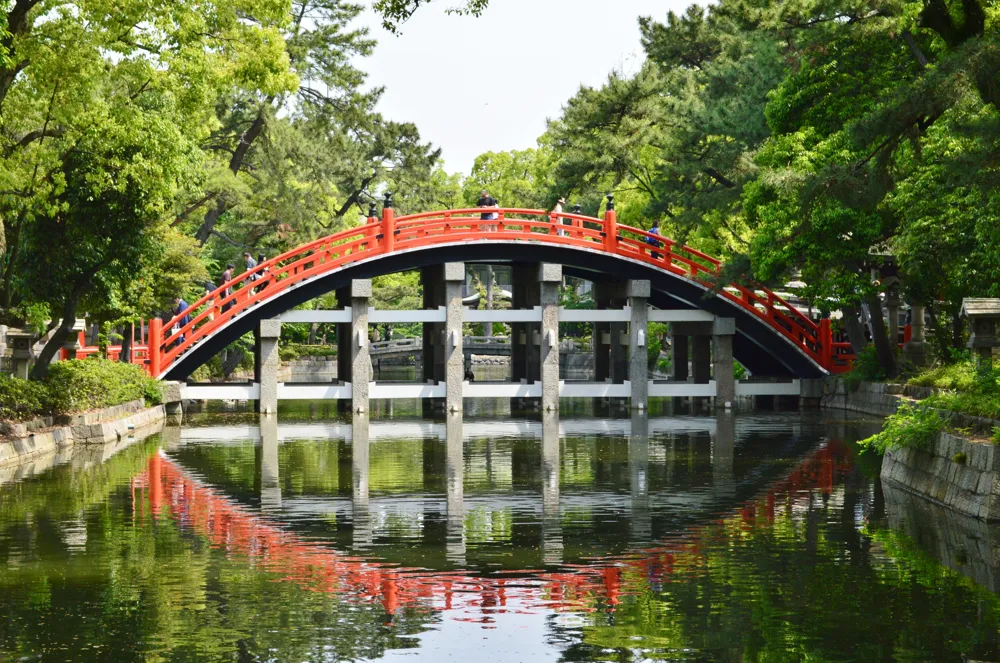
One of the most important myths in which they appear links them to Empress Jingū, a legendary 3rd-century figure. According to tradition, she received a divine oracle from Amaterasu and the Sumiyoshi Sanjin before setting out on an expedition to Korea. Thanks to their guidance, the mission succeeded, and upon her return she ordered the construction of the first shrine dedicated to them: the Sumiyoshi Taisha, in what is now Osaka. At that shrine, the empress herself would also be deified and worshipped alongside the three sea gods.
Main Shrines and Worship
The Sumiyoshi Taisha is the main site of worship for the Sumiyoshi Sanjin. Although its founding is traditionally attributed to Empress Jingū in 211 CE, there are even older shrines, such as the Sumiyoshi Jinja in Fukuoka, showing how widespread the cult was from Kyūshū to Kansai.
Since ancient times, sailors, fishermen, and merchants have visited these shrines to seek protection at sea. The old port of Suminoe-no-Tsu, near Sumiyoshi Taisha, was one of the main commercial and diplomatic centers of ancient Japan, which is why the Sumiyoshi gods were seen as guardians of national well-being.
The Osaka shrine remains a site of remarkable religious activity. Each of the three gods has its own pavilion within the precinct, and a fourth is dedicated to Empress Jingū. Every year, millions of people visit the shrine, especially at New Year and during the Sumiyoshi Matsuri, one of the city’s most notable festivals. Beyond their connection to the sea, worshippers today also pray to these gods for good fortune, love, fertility, and general protection.
Role in the Shinto Pantheon and Japanese Culture
In the Shinto pantheon, the Sumiyoshi Sanjin stand out as calm and benevolent gods of the sea, in contrast to other aquatic deities such as Ryūjin, who represents the more powerful and mysterious aspects of the ocean. Some studies suggest that the Sumiyoshi Sanjin and the Watatsumi may originally have been the same entity worshipped in different regions.
Their influence extends beyond religious worship. In Japanese folklore, the Sumiyoshi Sanjin appear as kind gods. In the tale of Issun-bōshi (the one-inch warrior), a childless couple prays to the Sumiyoshi and manages to conceive a tiny but brave son.
They are also important figures in classical literature. In the celebrated novel Genji Monogatari, the Sumiyoshi shrine appears as a key setting in the Akashi chapters. The Akashi lady’s father prays there for his daughter to have a good fate, and his prayers are answered when Prince Genji takes her as his consort. Her daughter, the Akashi princess, would go on to become empress. In this way, the Sumiyoshi are presented as gods of favorable destiny.
Legacy Today and Curiosities
Today, the Sumiyoshi Sanjin continue to be widely venerated. Their shrines, especially the one in Osaka, receive millions of visitors each year. Coastal communities maintain traditional rituals in their honor, and it is still believed that they grant safety to ships that set sail under their protection.
An interesting fact is that some researchers have linked the Sumiyoshi Sanjin to the three stars of Orion’s Belt. This constellation, visible in the night sky, is thought to have been used by ancient Japanese sailors as a navigation reference, which may have led to their deification as a celestial triad.
In short, the Sumiyoshi Sanjin show how Japanese mythology unites the natural with the spiritual. Born of the sea, protectors of empires, and guides of destiny, they continue to sail with us in the cultural memory of Japan.
Subscribe
If you want to receive stories, curiosities, and legends of the most fascinating creatures of classical mythology in your inbox, just fill out this form.
Continue reading
If you liked this article, you like mythology. And in this case, we have much more to offer you. Discover new adventures, heroes, nymphs, gods, battles, teachings… Just click on the button.
Watatsumi, the God of the Sea
The mysteries of the ocean have fascinated humanity since time immemorial, and many cultures have attributed its immensity and power to a maritime deity. In Japanese mythology, that deity is Watatsumi, also known as Ryūjin, the God of the Sea. This divine figure not...

Haya-akitsu-hime, the Goddess of the Sea
Exploring the legend of Haya-akitsu-hime, a gem of Japanese mythology.

Aizen, the God of Love and Wisdom
In the rich and diverse Japanese mythology, Aizen, the god of love and wisdom, is a central and fascinating figure. Over the centuries, this Buddhist figure has been the object of worship, admiration and study, and has influenced the culture, arts and spirituality of...

Susanoo: The Mighty God of the Sea and Battles
Susanoo, the god of the sea and battles in Japanese Shinto, is known for his complex relationship with his divine brothers Amaterasu and Tsukuyomi. His confrontations with the serpent Yamata-no-Orochi and his subsequent banishment to the earthly world stand out....

Nihon Shoki, history and mythology of Japan uncovered
The Nihon Shoki, also known as Nihongi, is an ancient book that narrates the history and mythology of Japan. It was completed in 720 and its pages contain accounts of Japanese gods, genealogies of emperors and historical facts.Although it has been the subject of...

Yokai: Mysterious Creatures of Japanese Mythology
Yokai are mysterious and supernatural creatures that are part of Japanese folklore. These creatures, with supernatural abilities and varied appearance, inhabit the border between the real and divine worlds. Although their relationship with humans is complex and...

Jorogumo: The Mysterious Harpy of Japanese Mythology
Jorogumo is an intriguing creature from Japanese mythology. According to legend, she is a spider woman who has the ability to transform herself. This magical being possesses supernatural powers and seduces her victims with her charm. In the article, we will explore...

mitologiaclasica.com is a website dedicated to exploring and popularizing the fascinating richness of mythology, offering a vast compendium of stories, characters, and legends.
Explore
Greek Mythology
Roman Mythology
Norse Mythology
Egyptian Mythology
Hindu Mythology
Chinese Mythology
Japanese Mythology
Celtic Mythology
Privacy Policy
Privacy Policy
Copyright mitologiaclasica.com