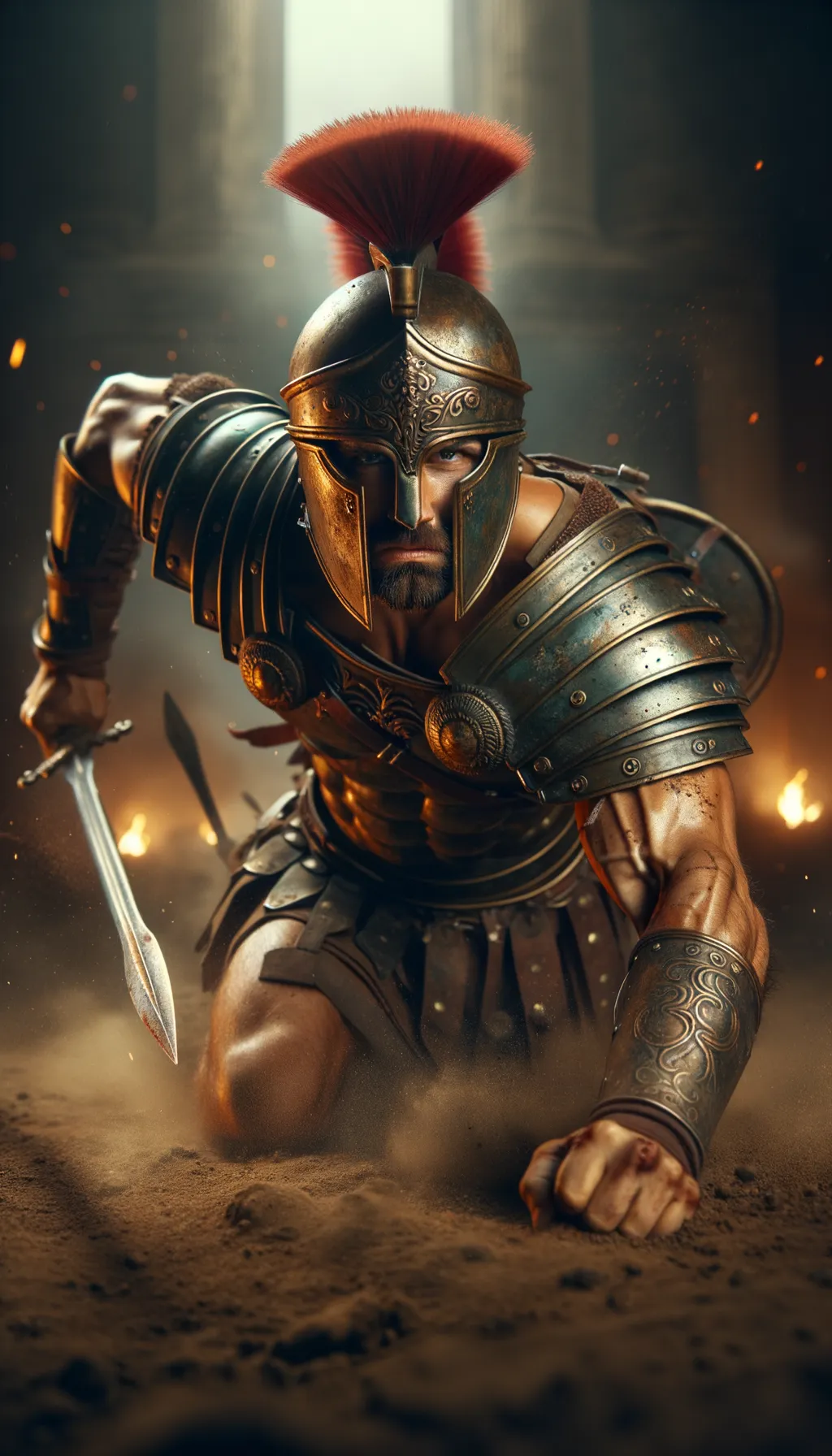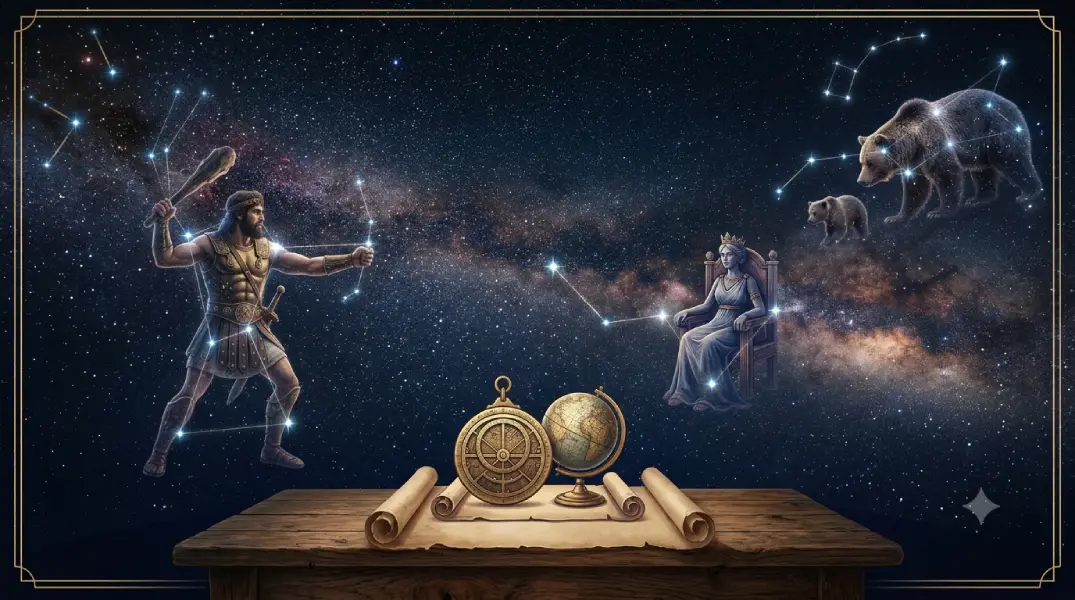
Every clear night, the sky stages a show that has been running for thousands of years: that of Greek myths and constellations. When we look up and recognize the silhouette of Orion or the curved line of Scorpius, we are in fact reading fragments of stories that the ancient Greeks inscribed among the stars so they would not be forgotten. It was neither chance nor mere decoration: it was a form of collective memory.
In this article we review the origin of this tradition, the most important constellations and the legends they represent, and why the link between myth and astronomy remains alive on today’s star charts. If you would like to refresh the general map of the subject first, take a look at our guide to Greek mythology: gods, heroes and legends or at the summary of the main Greek myths.
What is catasterism, and why did the Greeks “raise” myths to the sky?
The process by which a mythological figure, animal or object is transformed into a star or constellation is called catasterism (from the Greek katasterismós, “placing among the stars”). It was, in essence, a reward or a divine punishment: the gods fixed heroes, nymphs or creatures in the firmament as a reward for their valour, as consolation after a tragedy, or as an everlasting warning.
This device served several functions at once:
- Cultural memory: it fixed the great narratives on a medium the whole community could see and pass down from generation to generation.
- Practical use: it helped sailors and farmers orient themselves and calculate seasons, since the appearance of certain stars signalled harvests, sowing or safe sea routes.
- Explanation of the cosmos: it gave narrative meaning to a sky that would otherwise have seemed enigmatic.
Authors such as Eratosthenes, in his work Catasterisms, or the poet Aratus in the Phaenomena, systematically compiled these stories, laying the foundations of what Western astronomy would later inherit.
The best-known Greek constellations and their myths
Orion, the giant hunter
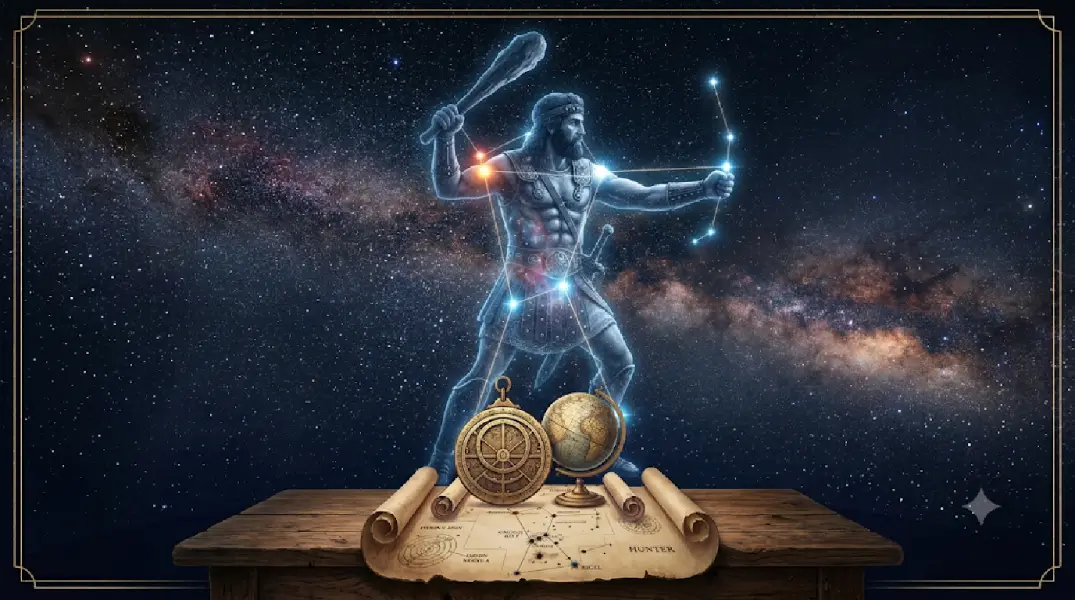
Orion is probably the most recognizable constellation of the winter sky, with its characteristic “belt” of three aligned stars. According to the myth, Orion was a hunter of enormous strength who boasted that he could kill any beast on Earth. As punishment for his arrogance, the goddess Gaia sent a scorpion that killed him with its sting. Zeus placed both in the sky, but at opposite ends: when Scorpius rises over the horizon, Orion sets, doomed never to meet.
Orion also features in another stellar myth: his pursuit of the Pleiades, the seven sisters whom Zeus turned into stars to protect them from him.
Cassiopeia and Andromeda, vanity and sacrifice
Cassiopeia, queen of Ethiopia, boasted that her beauty surpassed that of the Nereids. As punishment, Poseidon sent a sea monster to devastate the kingdom, and only the sacrifice of her daughter Andromeda, chained to a rock, could appease it. The hero Perseus rescued her just in time, and the gods immortalized the whole family in the sky: Cassiopeia, Cepheus, Andromeda and Perseus himself appear as neighbouring constellations, repeating the same scene every night.
Hercules, the kneeling hero
The constellation of Hercules depicts the demigod in the posture of “the kneeler”, traditionally associated with his Twelve Labours. It is one of the largest constellations in the sky, a tribute proportionate to the magnitude of his feats and to his central place in Greek mythology.
Gemini, the bond between brothers
Castor and Pollux were twin brothers, but only Pollux was immortal, the son of Zeus. When Castor died, Pollux asked to share his immortality with him rather than live forever apart. Zeus granted the wish and united them in the sky as the constellation Gemini, an enduring symbol of fraternal loyalty.
The Great Bear and the Little Bear
Callisto, a nymph seduced by Zeus, was transformed into a bear by the jealous Hera. Her son Arcas, about to hunt her without knowing who she was, nearly killed her, until Zeus intervened and turned both into constellations: the Great Bear and the Little Bear, joined forever in the northern sky.
Cygnus, Sagittarius and other figures of the zodiac
Cygnus recalls the form Zeus took to approach Leda; Sagittarius, depicted as an archer centaur, is often linked to Chiron, the wise teacher of heroes; and Leo evokes the Nemean Lion, the first of the beasts Hercules had to defeat. Practically the entire zodiac, including Taurus, Aries, Pisces and Capricorn, has a mythological story behind its name.
From myth to science: the legacy in modern astronomy
When in 1922 the International Astronomical Union (IAU) officially fixed the 88 constellations recognized today, it kept for the most part the names and boundaries inherited from the Greco-Roman tradition. This means that whenever a present-day astronomer speaks of Orion, Cassiopeia or Andromeda, they are using the same symbolic vocabulary the Greeks used more than two thousand years ago.
This continuity is no mere historical whim: it shows how mythology functioned as a first system for cataloguing the sky, long before telescopes existed. Myth and science, far from being opposites, shared for centuries the same task: bringing order and meaning to what we see when we look upward.
Conclusion
The relationship between Greek myths and constellations is not anecdotal: it is proof that, for the Greeks, the sky was a further extension of their culture, their morality and their way of explaining the world. Every figure we trace by joining stars —a hunter, a queen, inseparable brothers— is, in fact, a fragment of a story that survived because someone decided it deserved a place among the stars.
The next time you look at the night sky, you will know that you are not only observing stars: you are reading mythology.
Keep reading on mitologiaclasica.com
- Greek mythology: gods, heroes and legends — the complete guide for those new to the subject.
- What are the main Greek myths? — a review of the most influential stories.
- Greek heroes and demigods: legends that defy time — from Hercules to Perseus, including Theseus and Jason.
- Divine punishments in Greek mythology for defying the gods — the other side of catasterism: when hubris had consequences.
- The Pleiades: who were the Seven Sisters? — another stellar myth directly linked to Orion.
Frequently asked questions about Greek myths and constellations
Why did the Greeks link myths to constellations?
The Greeks used catasterism —the transformation of mythological figures into stars— to fix their stories in collective memory, to honour or punish their characters and, incidentally, to have a natural calendar useful for farming and navigation.
What are the most famous Greek constellations?
The best known are Orion, Cassiopeia, Andromeda, Perseus, Hercules, Gemini, the Great Bear and the Little Bear, and a good number of the zodiac signs, such as Leo, Taurus or Sagittarius.
What is catasterism?
Catasterism is the myth of transformation whereby a mythological being —human, animal or hybrid— is placed among the stars by the gods, usually as a reward, consolation or punishment.
Why do Orion and Scorpius never appear together in the sky?
Because, according to the myth, a scorpion killed Orion, and the gods placed them on opposite sides of the sky so that they would never meet again: when one sets below the horizon, the other is rising.
Do the current names of the constellations come from Greece?
Yes, to a large extent. The International Astronomical Union made the 88 modern constellations official in 1922, mostly keeping the names of the Greco-Roman mythological tradition.
Who compiled the myths of the constellations in Antiquity?
The main texts that systematized these stories were the Catasterisms, attributed to Eratosthenes, and the Phaenomena by Aratus, both key references for understanding the mythological origin of the constellations.
Subscribe
If you would like to receive stories, curiosities and legends about the most fascinating creatures of classical mythology in your inbox, just fill in this form.
Keep reading
If you enjoyed this article, you love mythology. And in that case, we have a lot more to offer you. Discover new adventures, heroes, nymphs, gods, battles, teachings… Just click the button.
Deimos, the God of Terror
If we venture into the fascinating universe of Greek mythology, we find Deimos, one of the least explored deities but with undeniable relevance. Deimos, whose name means "dread," is an enigmatic god linked to the darkest and most frightening aspects of human...
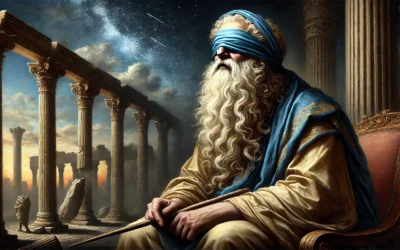
Tiresias, the Blind Prophet
One of the most intriguing and multifaceted characters in Greek mythology is Tiresias, the blind prophet of Thebes. This seer, who spent seven years as a woman before becoming a man again, plays a fundamental role in several literary works, including tragedies by...
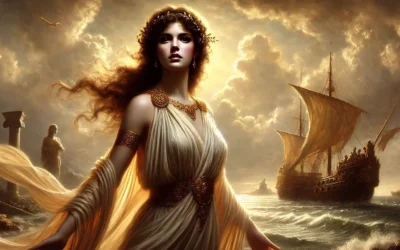
The Sacrifice of Iphigenia
Greek mythology is full of heroes, gods, and complex characters, each with their own stories and lessons. One of these figures, perhaps somewhat less well known, is Iphigenia, the unfortunate daughter of Agamemnon and Clytemnestra. Although her story is tragic, her...
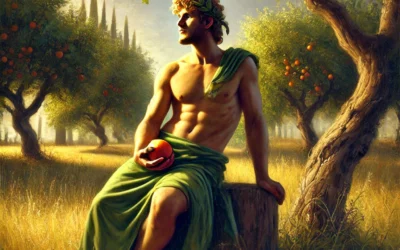
Erysichthon, Insatiable Hunger
The ancient stories of Greek mythology have fascinated humanity for thousands of years. Their narratives, full of gods, heroes, mythical creatures, and moral lessons, have influenced many cultures and remain relevant to this day. In this article, we will focus on one...
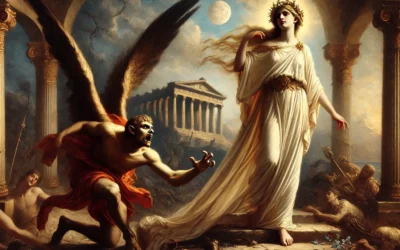
The Myth of Philomela and Procne
Today we discuss the myth of Philomela and Procne. It is a tragic and moving story from ancient Greek mythology, notable both for the rawness of its details and for its powerful symbolism. It is the story of two sisters, bound by unbreakable ties of loyalty and love,...
Leda and the Swan
Greek mythology is full of astonishing stories that have left an indelible mark on culture and art over the centuries. One of the most intriguing and controversial tales is that of "Leda and the Swan." The story of the seduction of the mortal Leda by the god Zeus...
Who Was the Goddess Atalanta?
Atalanta, an iconic figure in Greek mythology, is famous for her tireless speed and sharp wit. In a world dominated by men, she emerged as a heroine, defying conventional norms and forging her own path. In every tale about her life, her resilience and her ability to...
What Is the Story of Pygmalion and Galatea?
The names Pygmalion and Galatea resonate in the collective imagination. They are two figures who have inspired poets, writers, and artists throughout the centuries. The love story between the sculptor and his creation is one of the most moving and fascinating in Greek...
Nereus, the Old God of the Sea
Greek mythology is a vast mosaic of gods, heroes, and legendary entities, each with its own narrative and singular character. One of these gods is Nereus, an ancient sea deity who, although less well known than Poseidon, plays an important role in the Greek pantheon....

mitologiaclasica.com is a website dedicated to exploring and sharing the fascinating richness of mythology, offering a vast compendium of stories, characters and legends.
Explore
Greek Mythology
Roman Mythology
Norse Mythology
Egyptian Mythology
Hindu Mythology
Chinese Mythology
Japanese Mythology
Celtic Mythology
Privacy Policy
Privacy Policy
Copyright mitologiaclasica.com