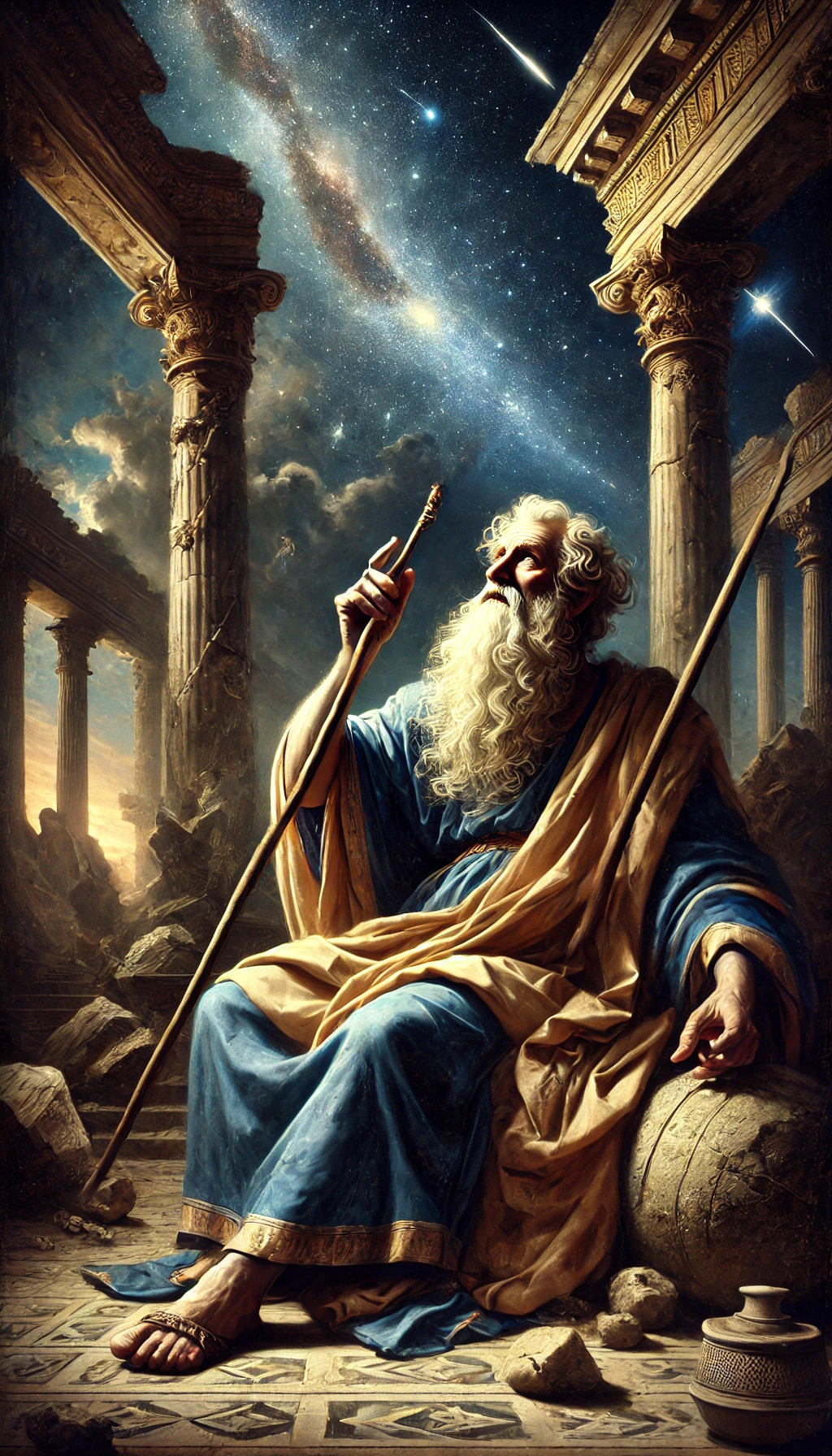
One of the most intriguing and multifaceted characters in Greek mythology is Tiresias, the blind prophet of Thebes. This seer, who spent seven years as a woman before becoming a man again, plays a fundamental role in several literary works, including tragedies by Sophocles and epics by Homer. In this article, we will explore his life, symbolism, and legacy in art, literature, and contemporary culture.
The Seer Tiresias
Tiresias was a figure in Greek mythology known for his supernatural gift of prophecy. Originally from Thebes, he was blind from childhood, but according to legend, this blindness was compensated with the gift of prophecy. His crucial role in many Greek myths reflects the ancient belief in divination and the oracle as means of knowing the future and the will of the gods.
From Man to Woman
The prophet Tiresias is also known for his singular gender transformation. According to one legend, he was transformed into a woman by the goddess Hera after he separated two mating snakes. He lived for seven years as a woman, until he had the chance to reverse the curse by finding the snakes again and leaving them undisturbed.
These elements of Tiresias’s life and personality make him a unique figure in Greek mythology, representing both wisdom and ambiguity. His figure is not only central to Greek myths, but also has a significant presence in ancient and modern literature.
The Importance of Tiresias in Ancient Literature
Tiresias appears in several classical texts of ancient Greece. As a seer, his role is essential in resolving conflicts and revealing hidden truths. For example, in Sophocles’s tragedy ‘Oedipus Rex,’ he plays a fundamental role in revealing the truth about Oedipus’s patricide and incest, despite Oedipus’s own resistance.
He also appears in Homer’s ‘Odyssey,’ where he fulfills a similar function. In the underworld, he gives the hero Odysseus the guidance needed to return home and warns him of the dangers that await him. This type of role is characteristic of seers in ancient literature, who often act as mediators between humans and the gods.
Finally, the figure of Tiresias highlights the importance of divination in ancient culture. Through him, the Greeks expressed their belief in the possibility of knowing the future and the will of the gods, as well as their fear of the consequences of defying these prophecies.
The Curse of Tiresias: A Transition Between Genders
The myth of Tiresias is fascinating for its bold transgression of gender norms. According to legend, Tiresias was transformed into a woman by the goddess Hera as punishment for striking two mating snakes. For seven years, he lived as a woman, experienced motherhood, and came to understand the world from a female perspective. This experience gave Tiresias a unique understanding of both genders, a perspective that would later be sought out by the gods.
When Zeus and Hera debated over who enjoyed sex more, men or women, Tiresias was called upon to settle the dispute. Speaking from his unique experience, he stated that women derive more pleasure from the act. Enraged by his answer, Hera blinded Tiresias, while Zeus granted him the gift of prophecy to compensate for his loss of sight. In this way, Tiresias’s curse became a blessing, as his blindness turned into an inner vision that allowed him to see the future and the secrets of the universe.
The Blind Prophet of Thebes
Despite his blindness, Tiresias became the most famous of all the prophets of ancient Greece. His ability to see beyond the veil of the present and predict the future earned him the respect of gods and men alike. In his native city of Thebes, Tiresias played a crucial role in several mythological events, often offering advice and warnings that, had they been heeded, might have prevented tragedies.
For example, it was he who warned King Oedipus of his terrible fate: that he would kill his father and marry his mother. However, Oedipus, in his arrogance, rejected Tiresias’s warning and ultimately fulfilled the terrible prophecy. Despite many people’s lack of faith in his words, his prophetic insight never failed, and his predictions always came true, even when ignored or rejected by those to whom they were addressed.
It was clear that Tiresias, despite his physical blindness, possessed an inner vision that allowed him to see clearly what others could not. His prophetic gift, granted by Zeus, allowed him to see the future and decipher the difficult riddles of the present. Through his story, we are reminded that wisdom and vision do not necessarily depend on physical sight, but often come from the ability to see beyond the surface and understand the hidden truths beneath.
His Role in Sophocles’s ‘Antigone’
The character of Tiresias plays a crucial role in Sophocles’s tragedy “Antigone,” acting as a voice of warning to Creon, king of Thebes. Blind but able to see the future, he warns Creon of the catastrophic consequences his actions could have. However, Creon refuses to listen, a decision that ultimately leads to his downfall.
The prophet Tiresias is presented here as an impartial figure who acts as a mediator between the gods and mortals. His wisdom and divinatory powers are respected, but also feared. Though blind, he sees beyond what mortals can see, which underscores the irony of his character and the figurative blindness of those who have sight.
Tiresias’s appearance in the play is a crucial turning point. Although his warnings go unheeded, his presence and words of warning resonate long afterward, serving as a tragic reminder of the will and power of the gods.
6. The Intersection of Divinity and Humanity in Tiresias
Tiresias occupies a unique place in Greek mythology, standing at the intersection of humanity and divinity. Although mortal, his gift of prophecy puts him in direct contact with the gods, serving as a bridge between both worlds.
Like the gods, Tiresias possesses knowledge that goes beyond human understanding. However, he remains a mortal, subject to the whims and punishments of the gods. This complex duality makes Tiresias a fascinating and multifaceted character.
Moreover, Tiresias’s story is one of transformation and adaptation. After being blinded by the goddess Hera, he is blessed by Zeus with the gift of prophecy, as well as longevity. These changes reflect the mutable nature of the gods, as well as the power struggle and rivalry between them.
Life After Death: Tiresias in Homer’s ‘Odyssey’
In Homer’s “Odyssey,” Tiresias appears once again, this time in the underworld. Although he is dead, he retains his gift of prophecy, and provides Odysseus with vital advice on how to complete his journey home.
This appearance highlights the continuity of Tiresias’s existence beyond death, a characteristic he shares with the gods. Although his mortal body has died, his spirit and his gifts persist. This persistence reinforces Tiresias’s unique status, which transcends the boundaries between life and death, between the mortal and the immortal.
Tiresias’s presence in the underworld also reinforces his role as mediator. Even in death, he serves as a link between the living and the dead, providing guidance and counsel to those in need.
Tiresias and the Sphinx: Riddles of Greek Mythology
The wise Tiresias also plays a crucial role in the story of the Sphinx, the mythological creature that tormented the city of Thebes with a riddle that no one could solve. According to legend, Tiresias was one of the few who knew the answer to the riddle, although he was not the one who ultimately solved it.
Tiresias’s role in this story is paradigmatic, as once again he finds himself in a position of superior knowledge. His ability to solve the Sphinx’s riddle highlights his wisdom and his connection to the divine.
However, the fact that it is not Tiresias who ultimately defeats the Sphinx, but Oedipus, highlights the limits of his power. Despite his knowledge and wisdom, he remains subject to the forces and designs of the gods.
The Link Between Gods and Mortals
The blind prophet, like no other character in Greek mythology, represents the link between gods and mortals. His role as seer, his ability to communicate with the gods, and his unique life experience make him a bridge between both worlds.
Tiresias is, in many ways, the perfect intermediary. Although human, his contact with the divine grants him an understanding and perspective that other mortals do not possess. However, his mortal condition also allows him to understand and sympathize with the human experience, making him an effective and compassionate mediator.
His role is not only to carry the gods’ messages to mortals, but also to convey mortals’ concerns and fears to the gods. This ability to communicate in both directions underscores Tiresias’s importance in Greek mythology.
Tiresias’s Legacy in Art and Contemporary Culture
The character of Tiresias has left an indelible mark on art and contemporary culture. He appears in a variety of media, from literature to music, to film and theater.
In literature, he is often used as an allegorical figure to examine themes of vision and blindness, knowledge and ignorance. His figure has been evoked by authors such as T.S. Eliot and James Joyce, who have explored his symbolism and his role in the context of Greek mythology.
In music, the British band Genesis dedicated a song to Tiresias on their album “The Lamb Lies Down on Broadway.” In film and theater, he has been portrayed in various ways, from a wise old man to a transsexual character, reflecting the diversity and complexity of his figure.
Beyond Divination
Although Tiresias is best known for his gift of divination, his role in Greek mythology goes beyond foreseeing the future. Tiresias is a complex and multifaceted character who plays a variety of roles.
On one hand, he is a mediator between the gods and humans, conveying the gods’ messages and warning humans of the consequences of their actions. But Tiresias is also a figure of resilience and adaptation, who survives and thrives despite adversity and the punishments of the gods.
He is also a figure of transformation, who undergoes radical changes in his life and adapts to them. His story is one of resilience and perseverance, demonstrating that even amid adversity, there can be wisdom and understanding.
Reflections on Gender Identity in Antiquity
Tiresias’s story also allows us to reflect on ancient ideas surrounding gender identity. According to mythology, Tiresias was transformed into a woman by Hera as punishment, and lived as such for seven years before returning to his original form.
This aspect of Tiresias’s story is fascinating, as it defies the gender norms of the time and offers insight into how the ancient Greeks might have understood gender identity and sexuality.
Tiresias, in his dual role as man and woman, also offers a unique perspective on the human experience. As such, his story can be seen as an early exploration of gender fluidity and the diversity of human experience.
Tiresias, with his story and unique gifts, holds a prominent place in Greek mythology. His role as mediator between gods and mortals, his ability to see the future, and his singular life experience set him apart from other mythological figures. By reflecting on the figure of Tiresias, we can learn much about ancient ideas concerning divinity, humanity, knowledge, and identity.
Subscribe
If you want to receive stories, curiosities, and legends of the most fascinating creatures of classical mythology in your inbox, just fill out this form.
Continue reading
If you liked this article, you like mythology. And in this case, we have much more to offer you. Discover new adventures, heroes, nymphs, gods, battles, teachings… Just click on the button.
TV Series About Greek Gods and Heroes
Greek mythology has been an endless source of inspiration for film and television. Over the decades, numerous series -both animated and live-action- have recreated the exploits of Olympian gods and legendary heroes, adapting them for different audiences. In this...

Love Stories Between Gods and Mortals in Greek Mythology
Greek mythology has left us many love stories between immortal gods and mortal humans, romances that fascinated the ancients and still captivate us today. These divine-mortal relationships are charged with passion, conflict, and symbolic lessons. They sometimes...
Divine punishments in Greek mythology for defying the gods
Greek mythology is populated with cautionary tales about punishments for defying the gods in Greek mythology. These myths illustrate how hubris—human arrogance or audacity before the divine—was severely punished by the Olympian gods. Through stories of exemplary...

The Mythical Hippocrene Spring
Greek mythology is full of stories in which the divine and the natural intertwine in ways that continue to amaze entire generations. Some of these stories tell of sacred mountains, celestial creatures, or springs that not only quench thirst but awaken dormant talents....

Short Greek Myths for Children
Short Greek myths for children are an excellent way to introduce little ones to this wonderful world full of gods, heroes, and fantastic creatures. These stories not only entertain, but also convey values and lessons and spark curiosity about ancient culture. In this...
Ino, the Goddess of the Sea
Immersed in the rich tapestry of Greek mythology, we find Ino, a mysterious figure who represents both human tragedy and the divinity of the sea. This complex and intriguing figure plays a fundamental role in numerous ancient legends and myths, and remains relevant in...
The Myth of Chrysippus
Greek mythology is a rich tapestry of heroes, gods, and monsters that have fascinated humanity for thousands of years. However, some characters who, though less well known, play a crucial role in these ancient stories are often overlooked. One such character is...

Erebus, the God of Shadow
Erebus, a mysterious and enigmatic figure in Greek mythology, has fascinated historians, archaeologists, and mythology enthusiasts for centuries. His role in the Greek cosmos, his relationship with other gods and goddesses, and his lasting influence on contemporary...
Phobos, the God of Fear
In the vast annals of Greek mythology, where gods and goddesses, heroes, and monsters intertwine in a dance of legends and myths, we find Phobos, a peculiar and often overlooked figure. Less well known than Zeus or Hercules, Phobos nevertheless offers a fascinating...

mitologiaclasica.com is a website dedicated to exploring and popularizing the fascinating richness of mythology, offering a vast compendium of stories, characters, and legends.
Explore
Greek Mythology
Roman Mythology
Norse Mythology
Egyptian Mythology
Hindu Mythology
Chinese Mythology
Japanese Mythology
Celtic Mythology
Privacy Policy
Privacy Policy
Copyright mitologiaclasica.com