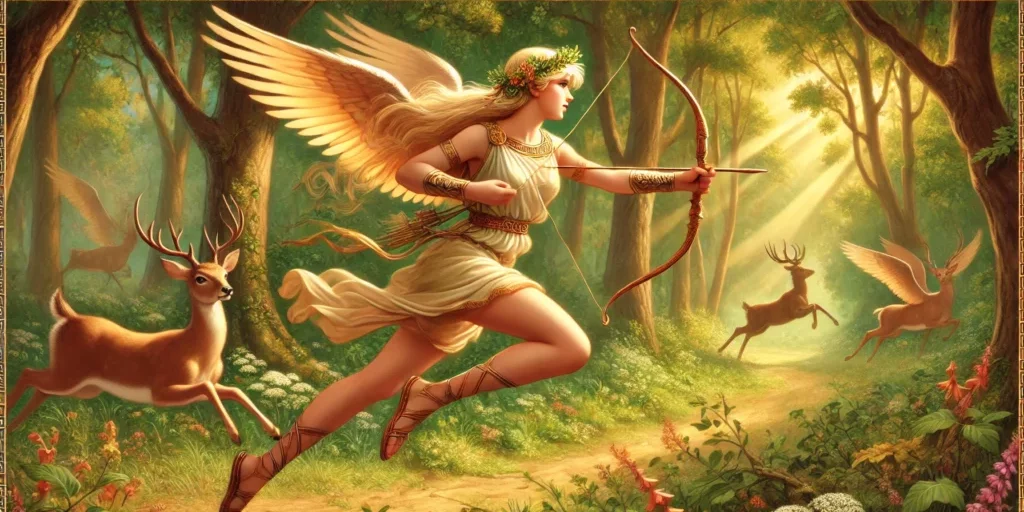
Atalanta, an iconic figure in Greek mythology, is famous for her tireless speed and sharp wit. In a world dominated by men, she emerged as a heroine, defying conventional norms and forging her own path. In every tale about her life, her resilience and her ability to overcome challenges stand out. Her story is a testament to her strength and courage, and continues to resonate in our modern culture. Let’s answer the question: Who was the goddess Atalanta?
A Heroine of Greek Mythology
When we speak of Atalanta, we refer to a central character in the narrative of female heroism. Her story intertwines with that of heroes known as Heracles and Jason, demonstrating her importance in the mythological pantheon. Atalanta, with her incredible ability to run faster than any man, has established herself as a legendary heroine.
Atalanta’s character is notably complex and multifaceted, setting her apart from other mythological heroines. She is not only a fast runner, but also a skilled huntress. Although she was a woman in ancient Greece, she never allowed the gender norms of her time to limit her potential or her ambitions.
From Abandonment to Glory: The Story of Atalanta
The heroine Atalanta was born the daughter of a king, but was abandoned on a mountain because of her sex. She was rescued and raised by a she-bear, and was later found and adopted by hunters. This experience of abandonment and survival from an early age shaped her endurance and her ability to overcome adversity.
Despite her unfortunate beginning, Atalanta became one of the most respected figures of her time. She demonstrated her skill in hunting and athletics, which earned her the recognition and admiration of heroes and gods alike.
A Heroine in a World of Men
In ancient Greece, a patriarchal society, Atalanta defied social norms and proved that women could match and surpass men in skill and courage. She was the only woman to take part in the Calydonian boar hunt and also competed in athletic events.
She refused to marry unless her suitor could beat her in a race, a goal that seemed almost impossible given her astonishing speed. Despite social pressures and gender expectations, she remained firm in her convictions and lived her life on her own terms.
Atalanta’s Race: A Defiant Love Story
Atalanta’s love story is as unusual as her life. It is said that she agreed to marry the man who could beat her in a race. However, to ensure she would only marry a man worthy of her, she set a condition: if the suitor lost the race, he would lose his life as well. Of all the men who took on this challenge, only one, Hippomenes, was clever enough to win the race. He used three golden apples, a gift from the goddess Aphrodite, to distract Atalanta and win the race.
The Calydonian Boar Hunt
If Atalanta is famous for one thing, it is her participation in the Calydonian boar hunt. This boar was sent by the goddess Artemis to punish the king of Calydon for forgetting to honor her. Atalanta, along with a group of men, including the famous hero Heracles, joined the hunt.
Despite being the only woman on the hunt, and despite the men’s initial objections, she was the first to wound the boar. Her skill and courage during the hunt solidified her status as a heroine and earned her the respect of her fellow hunters.
Hippomenes: The Only Man Able to Beat Atalanta
Hippomenes, also known as Melanion, was the only man who managed to beat Atalanta in a race and, therefore, claim her hand in marriage. However, he did not succeed through physical skill alone, but also through the clever use of three golden apples.
The apples, a gift from the goddess Aphrodite, were used by Hippomenes to distract Atalanta during the race. Every time Atalanta was about to overtake him, he threw an apple to divert her from her path, which ultimately allowed him to win the race.
The Golden Apples: Hippomenes’s Cunning
The story of how Hippomenes won over Atalanta with his cunning is one of the most famous in Greek mythology. Every time Atalanta was about to overtake him in the race, Hippomenes threw one of the three golden apples that Aphrodite had given him.
Each time Atalanta stopped to pick up an apple, Hippomenes gained ground. Although Atalanta always managed to catch up to him, the distraction of the apples ultimately allowed Hippomenes to win the race, and with it, Atalanta’s hand.
The Punishment of the Gods: The Tragic End of Atalanta and Hippomenes
Despite their love and marriage, Atalanta and Hippomenes met a tragic end. After their wedding, they forgot to thank Aphrodite for her help in the race. As punishment, they were transformed into lions by the goddess.
This tragic and cruel ending serves as a grim reminder of the wrath of the gods in Greek mythology. Despite their achievements and feats, Atalanta and Hippomenes could not escape the fate the gods had in store for them.
The Representation of Women in Ancient Greece
We are dealing with a unique character in Greek mythology due to her independence and her rejection of traditional gender roles. Despite the social restrictions of her time, Atalanta managed to make a name for herself and earn the respect of heroes and gods.
She represents the possibility of resistance and subversion within a patriarchal culture, and her story raises questions about the nature of power, independence, and female identity in ancient Greece.
Portrayals in Ancient Literature and Art
In writing, she is frequently portrayed as a virgin huntress, similar to the goddess Artemis. Artists frequently depict her in scenes of the Calydonian boar hunt or the race with Hippomenes.
In art, Atalanta is often depicted as a strong, agile woman, with a firm, determined stance. These depictions reflect her status as a heroine, and the importance of her story in Greek mythology.
From Mythology to Comics
Atalanta’s name extends beyond the realm of ancient mythology and has found its place in modern popular culture. She has been the subject of numerous interpretations, from literature and theater to comics and films.
For example, in the “Wonder Woman” comic book series, she is one of the Amazons, the legendary warrior women of Greek mythology. This modern text presents Atalanta as a strong character, in keeping with her portrayal in ancient culture.
Female Empowerment and Resilience
Atalanta’s story offers valuable lessons for modern times, particularly in terms of female empowerment and resilience. Despite the adversities she faced, she remained strong and refused to conform to traditional gender expectations.
Her story highlights the importance of independence and self-determination, as well as the ability to withstand adversity. In a world that often remains unequal in terms of gender, Atalanta’s story serves as a powerful reminder of women’s strength and resilience.
Subscribe
If you want to receive stories, curiosities, and legends of the most fascinating creatures of classical mythology in your inbox, just fill out this form.
Continue reading
If you liked this article, you like mythology. And in this case, we have much more to offer you. Discover new adventures, heroes, nymphs, gods, battles, teachings… Just click on the button.
TV Series About Greek Gods and Heroes
Greek mythology has been an endless source of inspiration for film and television. Over the decades, numerous series -both animated and live-action- have recreated the exploits of Olympian gods and legendary heroes, adapting them for different audiences. In this...

Love Stories Between Gods and Mortals in Greek Mythology
Greek mythology has left us many love stories between immortal gods and mortal humans, romances that fascinated the ancients and still captivate us today. These divine-mortal relationships are charged with passion, conflict, and symbolic lessons. They sometimes...

Divine punishments in Greek mythology for defying the gods
Greek mythology is populated with cautionary tales about punishments for defying the gods in Greek mythology. These myths illustrate how hubris—human arrogance or audacity before the divine—was severely punished by the Olympian gods. Through stories of exemplary...

The Mythical Hippocrene Spring
Greek mythology is full of stories in which the divine and the natural intertwine in ways that continue to amaze entire generations. Some of these stories tell of sacred mountains, celestial creatures, or springs that not only quench thirst but awaken dormant talents....

Short Greek Myths for Children
Short Greek myths for children are an excellent way to introduce little ones to this wonderful world full of gods, heroes, and fantastic creatures. These stories not only entertain, but also convey values and lessons and spark curiosity about ancient culture. In this...
Ino, the Goddess of the Sea
Immersed in the rich tapestry of Greek mythology, we find Ino, a mysterious figure who represents both human tragedy and the divinity of the sea. This complex and intriguing figure plays a fundamental role in numerous ancient legends and myths, and remains relevant in...
The Myth of Chrysippus
Greek mythology is a rich tapestry of heroes, gods, and monsters that have fascinated humanity for thousands of years. However, some characters who, though less well known, play a crucial role in these ancient stories are often overlooked. One such character is...

Erebus, the God of Shadow
Erebus, a mysterious and enigmatic figure in Greek mythology, has fascinated historians, archaeologists, and mythology enthusiasts for centuries. His role in the Greek cosmos, his relationship with other gods and goddesses, and his lasting influence on contemporary...
Phobos, the God of Fear
In the vast annals of Greek mythology, where gods and goddesses, heroes, and monsters intertwine in a dance of legends and myths, we find Phobos, a peculiar and often overlooked figure. Less well known than Zeus or Hercules, Phobos nevertheless offers a fascinating...

mitologiaclasica.com is a website dedicated to exploring and popularizing the fascinating richness of mythology, offering a vast compendium of stories, characters, and legends.
Explore
Greek Mythology
Roman Mythology
Norse Mythology
Egyptian Mythology
Hindu Mythology
Chinese Mythology
Japanese Mythology
Celtic Mythology
Privacy Policy
Privacy Policy
Copyright mitologiaclasica.com