What Is the Mahabharata?
When we speak of humanity’s great epics, the Mahabharata holds a special place. Not only because of its colossal size —it is longer than The Iliad and The Odyssey combined— but because of the richness of its content, which interweaves history, religion, philosophy, and mythology. Considered one of the fundamental texts of Indian culture, the Mahabharata is much more than an epic narrative: it is an encyclopedia of the human soul, a work that has profoundly influenced Hindu thought and continues to fascinate millions of people around the world.
A Millennia-Old, Monumental Text
The Mahabharata was composed between the 5th century BCE and the 2nd century CE, although it draws on a much older oral tradition. It is attributed to the sage Vyasa, who is also a character within the story itself. Its name literally means “the great story of the Bharatas,” referring to the royal lineage at the heart of the tale.
With more than 200,000 verses spread across 18 books or parvas, it is the longest epic ever written. Its core is the war of Kurukshetra, a battle between two branches of the same royal family: the Pandavas and the Kauravas. But the Mahabharata is not limited to recounting a war: it offers reflections on duty (dharma), justice, morality, fate, and human passions.
The Protagonists: Heroes, Gods, and Moral Dilemmas
At the center of the epic are the five Pandava brothers —Yudhishthira, Bhima, Arjuna, Nakula, and Sahadeva— sons of King Pandu and various deities. These princes embody different virtues: justice, strength, skill, wisdom, and beauty. On the other hand, the hundred Kauravas, led by Duryodhana, represent pride, excessive ambition, and rivalry.
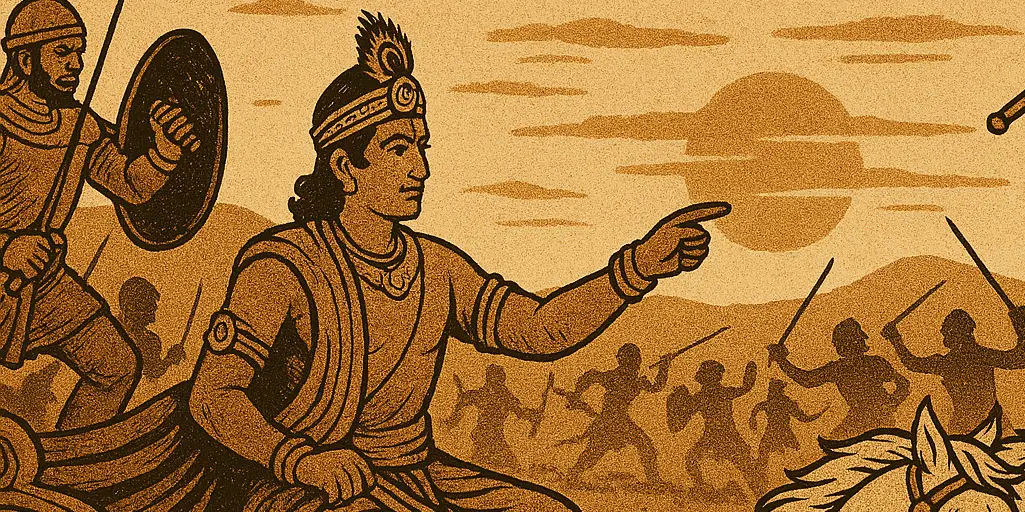
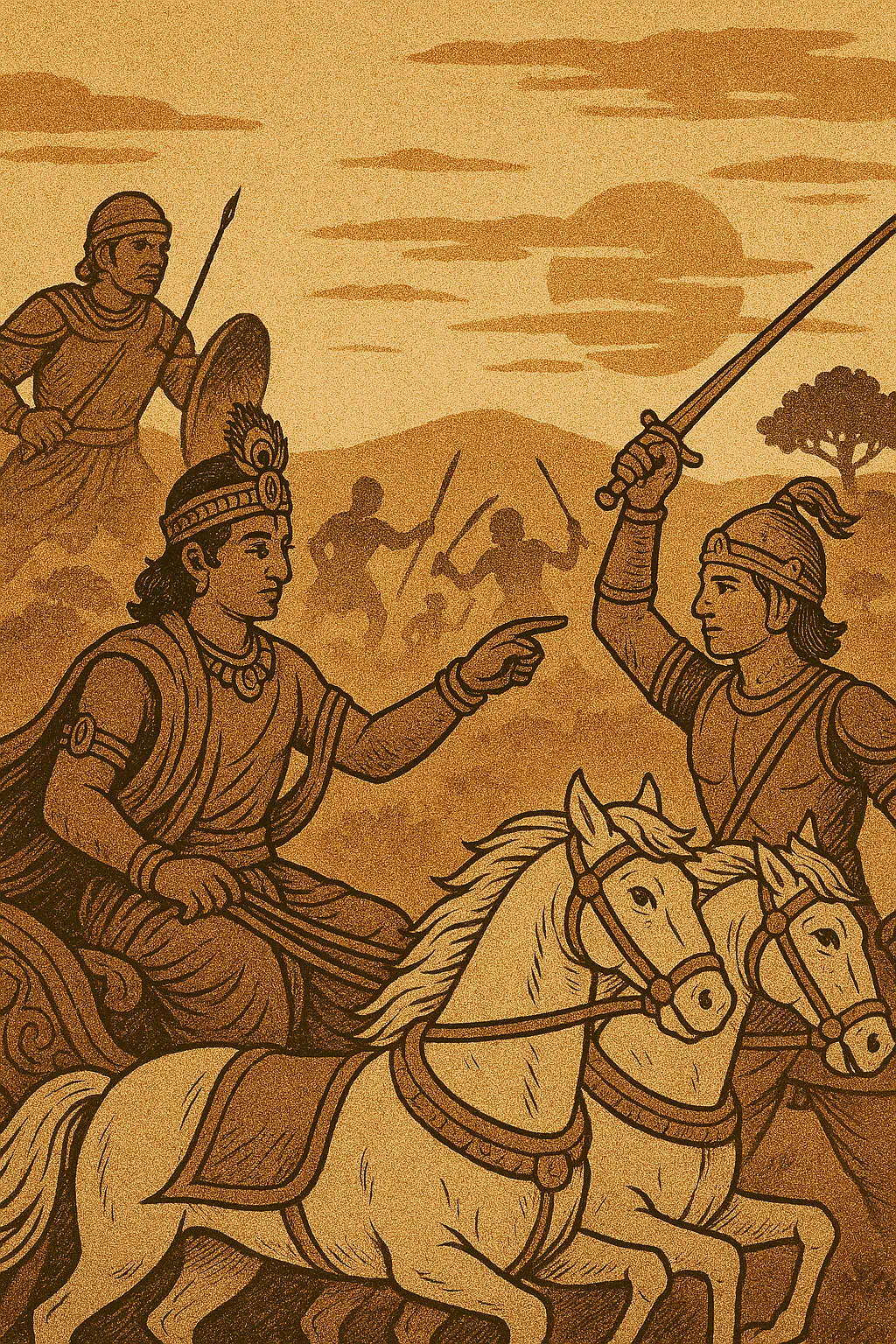
One of the most prominent characters in the Mahabharata is Krishna, an incarnation of the god Vishnu, who acts as counselor, charioteer, and spiritual guide. His role goes beyond the political: he is a divine figure who introduces profound philosophical teachings, especially in the poem’s best-known section, the Bhagavad Gita.
The Bhagavad Gita: The Soul of the Mahabharata
Within Book VI of the Mahabharata, titled Bhishma Parva, is found the Bhagavad Gita or “Song of the Lord,” a dialogue between Krishna and Arjuna just before the war begins. Arjuna, overwhelmed at having to fight against his own relatives, hesitates to enter battle. Krishna then explains to him the foundations of dharma, the nature of the soul, karma, and the importance of detachment in action.
This passage, just 700 verses long, has become an independent and sacred work within Hinduism. The Gita transcends the epic narrative to become a universal philosophical treatise on how to act correctly amid uncertainty and conflict.
The War of Kurukshetra: An Epic Tragedy
The conflict between the Pandavas and the Kauravas unfolds over numerous chapters describing alliances, betrayals, military strategies, and personal confrontations. The war lasts 18 days, and each day is marked by dramatic episodes, memorable duels, and complex moral decisions.
Among the most intense moments are the death of Abhimanyu, Arjuna’s young son, and the duel between Bhima and Duryodhana. In the end, the Pandavas prevail, but the victory brings neither glory nor happiness. The land is left devastated, and the survivors bear the weight of their actions.
A Universe of Stories Within the Story
The Mahabharata is not just the story of a war: it is a compendium of myths, fables, parables, genealogies, and legends that enrich its narrative world. Some of these stories have become famous in their own right, such as:
- The story of Nala and Damayanti, a tragic tale of love and fate.
- The birth of Ganesha, the elephant-headed god, though more closely associated with the Mahabharata through his role as the sage Vyasa’s scribe.
- Bhishma’s vow, a warrior who renounces the throne and marriage to allow for his father’s happiness.
- The story of Draupadi, the shared wife of the five Pandavas, and her humiliation at court, one of the most tense and symbolic moments of the entire epic.
Universal Themes: Why Is the Mahabharata Still Relevant?
Despite its antiquity, the Mahabharata remains relevant because it touches on universal themes. It is not a story of perfect heroes and evil villains, but of complex human beings caught between duty, desire, tradition, and freedom. Arjuna’s dilemma is, at its core, the dilemma of anyone who must choose between what is right and what they desire.
Moreover, the text reflects a worldview in which everything is interconnected: individual action reverberates through the cosmic order, and spirituality is not separate from everyday life but is expressed in decisions, relationships, and emotions.
Cultural Influence and Legacy
The Mahabharata has profoundly influenced the culture of India and Southeast Asia. It has inspired theatrical, musical, film, and television adaptations. One of the most famous was the Indian television series broadcast in the 1980s, which captivated millions of viewers and is considered a milestone in the country’s television history.
It has also inspired philosophers, politicians, artists, and writers. Gandhi, for example, considered the Bhagavad Gita his spiritual guide. And in literature, authors such as Rabindranath Tagore, Peter Brook, and Salman Rushdie have drawn on its symbolism.
An Epic to Read and Reread
Reading the Mahabharata is embarking on a journey. It can be challenging due to its length, philosophical complexities, and vast universe of characters. But it is also deeply enriching. Each reading reveals new layers of meaning, new angles from which to view life, duty, love, and death.
There are versions adapted for every kind of reader: from narrative summaries to full translations with philosophical commentary. And each one allows this immense work to be approached from different perspectives: as a sacred text, a historical narrative, a literary epic, or an existential reflection.
Mahabharata, a Universal Work
The Mahabharata is not just a gem of Indian mythology: it is a universal work that speaks to the human heart. Through the story of a war between relatives, it invites us to look within ourselves and ask what it means to act with justice, how to deal with suffering, and what role fate plays in our lives.
Ultimately, the Mahabharata is an eternal epic. A mirror of the human and the divine. A story that, though told millennia ago, still has something meaningful to tell us today.
Subscribe
If you want to receive stories, curiosities, and legends of the most fascinating creatures of classical mythology in your inbox, just fill out this form.
Continue reading
If you liked this article, you like mythology. And in this case, we have much more to offer you. Discover new adventures, heroes, nymphs, gods, battles, teachings… Just click on the button.

Mount Kailash: the holiest mountain in Asia
Mount Kailash rises in the remote west of Tibet as a peak wrapped in mysticism and veneration. At 6,638 meters above sea level, this mountain remains untouched since time immemorial, never climbed by mountaineers due to its sacred character. In fact, it is...

Karma and Reincarnation in Hindu Mythology
Karma and reincarnation are two fundamental concepts of the Hindu worldview, intimately intertwined in its mythological, philosophical, and spiritual beliefs. These ideas explain the fate of the soul across multiple lives and promote a moral understanding of the...

What Are the 18 Puranas?
Today we discuss the Puranas, a vast collection of ancient texts from India that are a cornerstone of Hindu mythology. This sacred archive of stories and legends has guided the religious practices, cultural customs, and philosophical understanding of millions of...

Ananta Shesha, the Cosmic Serpent
Ananta Shesha: the titanic cosmic serpent of Hindu mythology

Varuna, the God of the Oceans and Justice
In the vast and rich pantheon of Hindu mythology, Varuna stands out as one of the most complex and fascinating figures. Due to his role as god of water and guardian of moral law, he plays a central function in Hindu cosmology and shows an intriguing evolution...
Surya, the god of the sun
Hindu mythology, rich and colorful, is an intricate tapestry of deities, stories, and symbolism woven together to form a fabric of faith and philosophy. Among these, the solar god Surya holds a place of distinction. This article will explore his role, his presence in...
Agni, the god of fire
In ancient Eastern traditions, few gods hold an importance comparable to that of Agni, a central figure in Hindu mythology. As the god of fire, he has played a crucial role in the religion, culture, and daily life of Hindus for thousands of years. In this exploration,...
Trimurti: The sacred trinity of Hindu mythology
Trimurti is the supreme trinity of Hindu mythology, consisting of Brahma, Vishnu and Shiva. These gods represent the creation, preservation and destruction of the universe. Shiva, known as the destroyer and reborn god, occupies a fundamental role in Hinduism. On the...

mitologiaclasica.com is a website dedicated to exploring and popularizing the fascinating richness of mythology, offering a vast compendium of stories, characters, and legends.
Explore
Greek Mythology
Roman Mythology
Norse Mythology
Egyptian Mythology
Hindu Mythology
Chinese Mythology
Japanese Mythology
Celtic Mythology
Privacy Policy
Privacy Policy
Copyright mitologiaclasica.com