The Metamorphoses of Ovid is an epic-mythological poem written by the Roman poet Publius Ovidius Naso, considered a masterpiece of Latin literature. Completed around 8 CE, this extensive composition in dactylic hexameter spans fifteen books and more than 250 interwoven tales.
What Is the Metamorphoses of Ovid About?
Throughout its verses, Ovid narrates the mythical history of the world from the creation of the cosmos to the deification of Julius Caesar, weaving together numerous Greco-Roman legends around a common thread: transformation. In this article, we take an in-depth look at the structure, purpose, and main stories of Ovid’s Metamorphoses, in a journey through this classic work.
General Summary of Ovid’s Metamorphoses
Structure and Purpose of the Poem
The Metamorphoses form a cohesive collection of myths and legends whose common element is the physical transformation of gods, heroes, and mortals. The stories are organized in mythical chronological order, beginning with the origin of the universe and moving through divine and heroic generations up to Ovid’s own time, during the reign of Emperor Augustus. In this way, the poet creates a kind of mythical history of the world, freely combining Greek and Roman mythology with certain historical events, to create a sense of continuity from the beginnings of the cosmos to imperial Rome.
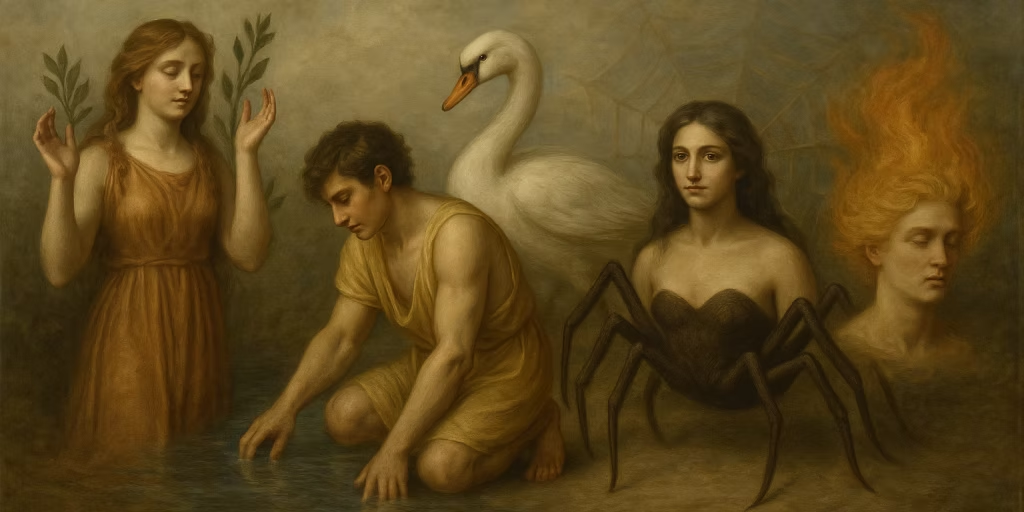
Each story includes some kind of metamorphosis —people turned into stars, plants, animals, springs, rocks, and so on— whose purpose is often to explain the origin of various elements of the natural or cultural world. For example, certain myths explain the appearance of stars in the sky, of particular plants, or even of religious festivals, following the transformation of a character.
Narrative Features and Style
Ovid displays a fluid, elegant, and vivid narrative style, masterfully linking one story to the next. Although it is an epic poem in verse, it lacks a single central hero, which makes it difficult to classify the work as either traditional epic or didactic poetry. The poet instead acts as a narrator compiling multiple stories, using clever devices to transition from one myth to the next: sometimes a secondary character tells a legend, other times the plots are chained together through genealogical or geographical links between characters.
The language used is richly poetic, with abundant sensory imagery and detailed descriptions that allow the reader to visualize each prodigious transformation. Ovid frequently resorts to the personification of nature and elaborate similes to lend credibility and wonder to the magical changes he narrates. Thanks to these techniques, even the most incredible metamorphoses (women becoming trees, young people turned into flowers, and so on) seem believable within the mythological universe created by the poet.
The tone of the stories ranges from tragic to humorous. They include romantic and moralizing elements. Many metamorphoses occur as divine punishment for arrogance or human offenses. Others result from love, whether unrequited or excessive. Some represent a form of escape or consolation in the face of a cruel fate.
Featured Myths from Ovid’s Metamorphoses
The richness of the work is such that it encompasses hundreds of fables and characters. Below, we explore some of the most notable myths included in Ovid’s Metamorphoses.
Apollo and Daphne
One of the most famous tales is that of Apollo and Daphne. Apollo, god of the sun, mocks Eros, who in revenge shoots two arrows: a golden one at Apollo, which causes love, and a leaden one at Daphne, which causes rejection. Hopelessly in love, Apollo pursues Daphne, who flees in terror. Just as he is about to catch her, Daphne begs her father, the river god Peneus, for help. He transforms his daughter into a laurel tree to protect her.
Apollo, devastated, embraces the tree and consecrates it as his eternal symbol. Thus, the laurel becomes the emblem of the god and a symbol of glory.
Narcissus and Echo
Narcissus was a young man of extraordinary beauty who scorned everyone who loved him. Echo, a nymph condemned to repeat only the last words she heard, falls in love with him but is cruelly rejected. Full of vanity, Narcissus ends up falling in love with his own reflection in the water and, unable to reach it, wastes away until he dies.
From his body springs a flower bearing his name, the narcissus. Echo, for her part, fades away until only her voice remains, still echoing through mountains and valleys. This myth illustrates the tragedy of unrequited love and the punishment of pride.
Phaethon
Phaethon, son of the sun god Helios, wishes to drive the chariot of the Sun to prove his divine origin. Helios, despite his warnings, grants the wish. Lacking the necessary strength and skill, Phaethon loses control of the chariot, scorching parts of the Earth and freezing others.
Zeus, to prevent a greater catastrophe, strikes him down with a thunderbolt. Phaethon falls into the river Eridanus. His sisters, the Heliades, weep for him and are transformed into poplar trees; their tears turn into amber. The myth conveys the danger of excessive ambition and explains natural phenomena.
Philemon and Baucis
A heartwarming story of hospitality and virtue. Zeus and Hermes, disguised as beggars, visit a village seeking shelter. Everyone turns them away, except for a humble elderly couple, Philemon and Baucis, who welcome them generously. The gods, grateful, save them from a flood that destroys the village and transform their hut into a temple.
As a reward, they are granted the gift of dying together. At the end of their lives, they are turned into intertwined trees, one an oak and the other a linden, so they may remain united forever.
Other Notable Myths
The work is full of fascinating tales:
- Actaeon, turned into a stag for seeing Diana naked and devoured by his own hounds.
- Arachne, turned into a spider for daring to compete with the goddess Minerva in the art of weaving.
- Orpheus and Eurydice, whose story of love and loss remains one of the most moving in classical mythology.
- Midas, a greedy king who turns everything he touches to gold, until his gift becomes a curse.
- Niobe, who through her pride loses her children and is transformed into a rock that weeps eternally.
- Perseus and Andromeda, a heroic story combining rescue, monsters, and triumphant love.
A Classic of Literature: The Metamorphoses of Ovid
Ovid’s Metamorphoses is a unique work in classical literature. Its thematic unity, transformation, becomes a vehicle for exploring human passions, divine punishments, and the mythical origins of the world. With an immersive poetic style, Ovid invites us on a journey where every change reveals a deep truth or moral lesson.
Each story gathered in this mythological compendium is a universe of its own. And even without considering its later influence, Ovid’s Metamorphoses remains, on its own, an essential work for understanding the symbolic richness of ancient thought.
Subscribe
If you want to receive stories, curiosities, and legends of the most fascinating creatures of classical mythology in your inbox, just fill out this form.
Continue reading
If you liked this article, you like mythology. And in this case, we have much more to offer you. Discover new adventures, heroes, nymphs, gods, battles, teachings… Just click on the button.
Who Is Janus and Why Does He Have Two Faces?
Roman antiquity is full of myths and legends. One of the most fascinating and enigmatic figures of the period is Janus, the two-faced god. This god, who is both familiar and puzzling, has been the subject of countless debates and analyses over the centuries. This...
Mors, the Personification of Death
In antiquity, the Romans explained the mysteries of life and death through their gods and goddesses. In this sense, Mors, the personification of death in Roman mythology, held an important place in their pantheon. Death, which is always present and feared, but also...

Somnus, el dios del sueño
La mitología romana, con su alucinante colección de dioses, diosas, monstruos y héroes, ha sido fuente de inspiración para la literatura y el arte durante siglos. Entre estas divinidades, uno que tiene un papel bastante intrigante es Somnus, el dios del sueño. Su...

Lares and Penates: The Guardian Gods of the Home in Rome
In ancient Rome, faith was not confined to large temples or public ceremonies; it also flourished in the most intimate areas of the home. The Lares and Penates, known as the "gods of the household," were fundamental to the everyday spirituality of Roman families....
Iris, the Messenger of the Gods
Roman mythology, rich and fascinating, is full of powerful and mysterious characters who have fascinated humanity for centuries. A particularly intriguing figure is Iris, the messenger of the gods and queen of the rainbow. This article will explore in depth who this...

Faunus, the god of the forest
In the vast pantheon of Roman mythology, one figure stands out for his close connection to nature and his role as protector of the forests and wildlife. His name is Faunus, a deity characterised by his semi-human appearance and his important role in the daily life of...
Who fell in love with Cupid?
In every love story that unfolds, in every love-struck moment that disarms us, and in every poem of passion that moves us, we find the shadow of the Roman god of love: Cupid. His figure, though ancient, is still alive in our culture and in our conceptions of love....
Trivia, the goddess of the three roads
When we delve into the vast universe of Roman mythology, we discover a myriad of gods and goddesses, myths and legends that make up a fascinating web of beliefs and traditions. Within this framework, the trivia occupy a singular place. Although the term may bring to...

Ops, the mother goddess
In the pages of history, we find fascinating characters who have left their mark on human civilisation. One of those figures is Ops, the mother goddess in Roman mythology. Although she is not as well known as other deities, she has many facets that make her unique and...

mitologiaclasica.com is a website dedicated to exploring and popularizing the fascinating richness of mythology, offering a vast compendium of stories, characters, and legends.
Explore
Greek Mythology
Roman Mythology
Norse Mythology
Egyptian Mythology
Hindu Mythology
Chinese Mythology
Japanese Mythology
Celtic Mythology
Privacy Policy
Privacy Policy
Copyright mitologiaclasica.com