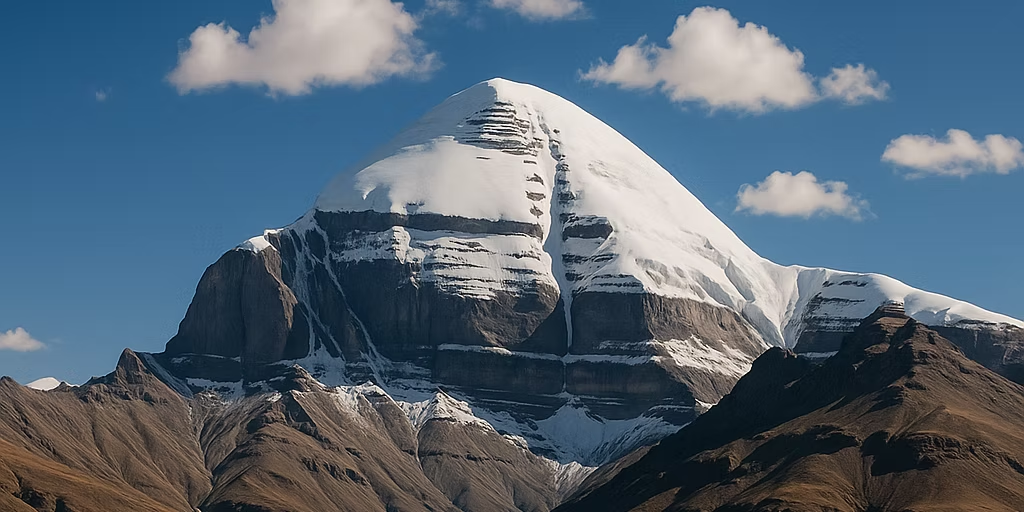
Mount Kailash rises in the remote west of Tibet as a peak wrapped in mysticism and veneration. At 6,638 meters above sea level, this mountain remains untouched since time immemorial, never climbed by mountaineers due to its sacred character. In fact, it is considered the holiest mountain in Asia, a pristine place that humanity has almost never dared to disturb. Up to five religions – Hindus, Buddhists, Jains (including certain Sikh traditions), and the Bön faith – venerate Mount Kailash. Despite its imposing height, what stands out most is its almost perfect pyramidal shape and its isolation on the Tibetan plateau, qualities that have turned Kailash into a spiritual symbol and a pilgrimage destination for thousands of devotees each year.
Geographic Location and Physical Characteristics
Mount Kailash is part of the Gangdisê mountain range, in the Ngari region, in the far west of Tibet. It lies near the triple border between China, India, and Nepal, dominating the Tibetan plateau. Some of Asia’s longest and mightiest rivers rise in its surroundings, such as the Indus River, the Sutlej, the Brahmaputra, and the Karnali (a tributary of the Ganges). At the foot of the mountain lies a plain where two twin lakes of great symbolism rest: Manasarovar and Rakshastal. The first, round in shape, is a freshwater lake associated with the Sun and considered holy in several traditions; the second, curved in shape, has brackish waters and is associated with the Moon and, in ancient times, with negative forces.
Taken together, the landscape of Kailash is overwhelming: the mountain displays four steep faces, oriented almost perfectly toward the cardinal points. Its slopes show horizontal bands of rock and snow that, seen from a distance, form the pattern of a natural swastika in the sunlight, a detail that feeds its mystical character. Kailash rises in solitude, far from other peaks of similar height, which enhances its majestic figure against the sky. This singular mountain, unlike the neighboring peaks of the Himalayas, has never been climbed; there are no recorded ascent attempts, out of deference to the religious beliefs surrounding it. Its summit remains inviolate as a natural sanctuary, a reminder of human smallness before the sacred.
Religious and Spiritual Significance of Mount Kailash
Mount Kailash holds a central place in the worldview of many Asian cultures and religions. From India to Tibet, different traditions have granted this mountain a unique sacred role. Below we explore its importance in the main religions that venerate it.
Mount Kailash in Hinduism
In the Hindu tradition, Mount Kailash is known as the abode of the god Shiva, the “Destroyer” in the divine trinity. According to mythology, Shiva resides at the summit of Kailash in eternal meditation, accompanied by his consort, the goddess Parvati. For many Hindus, this mountain is not only Shiva’s home but also a symbol of paradise and the final destination of souls freed from the cycle of reincarnation. Popular belief holds that Kailash physically represents Shiva’s lingam, while Lake Manasarovar at its feet personifies Parvati’s yoni.
Hindu sacred texts abound with references to Kailash. In the Puranas, for example, this mountain is described as the axis of the world, the central pillar of the universal mandala around which everything turns. Its four faces are said to be made of precious stones: crystal, ruby, gold, and lapis lazuli. According to these scriptures, four rivers flow from it, dividing the world into the four cardinal regions. This mythical concept identifies Kailash with Mount Meru, the cosmic mountain of Hindu cosmology.
Mount Kailash in Buddhism
For Buddhists, especially in Tibet, Kailash also holds deep meaning. In Tibetan Buddhism it is called Kang Rinpoche (“Precious Jewel of Snow”) and is associated with Mount Meru, regarded as the cosmic axis of the universe. Many Buddhist traditions see Kailash as the earthly home of important deities. In Tantric Buddhism, for example, it is believed that Chakrasamvara, a celestial Buddha who personifies supreme bliss, resides at its summit. Likewise, three lesser peaks surrounding Kailash are symbolically identified as the dwellings of compassionate bodhisattvas.
A popular tale from Tibetan folklore links Kailash to the story of Buddhism’s arrival in Tibet. In the 11th century, the Buddhist yogi Milarepa traveled to this mountain to face the shaman Naro-Bönchung, champion of the ancient Bön religion, in a duel of powers. According to legend, both masters competed to climb the mountain, but Milarepa won by invoking his power and riding a ray of sunlight to the summit, symbolizing the victory of Buddhism over the ancient faith.
Mount Kailash in Jainism
The Jain religion also places Mount Kailash within its sacred map. Jains refer to this mountain as Ashtapada, meaning “eight steps.” According to Jain scriptures, it was at the summit of Kailash/Ashtapada that Rishabhadeva, the first of the 24 Tirthankaras, attained final spiritual liberation. For this reason, the mountain is revered as a place of enlightenment in the Jain faith.
Mount Kailash in the Bön Religion
The Bön faith, Tibet’s ancestral religion predating the arrival of Buddhism, considers Kailash its most venerated mountain. For followers of Bön, Mount Kailash – which they call Tise – is the abode of the sky goddess Sipaimen. In Bönpo mythology, Kailash occupies the center of the legendary kingdom of Zhang Zhung. It is poetically referred to as the “Nine-Story Swastika Mountain,” representing a nine-level cosmic axis connecting heaven, earth, and the underworld.
The Pilgrimage to Mount Kailash (Kora)
Every year, thousands of people of diverse beliefs undertake the arduous journey to Mount Kailash. The pilgrimage to Kailash, known as kora, consists of circling on foot around the sacred mountain, covering a path of approximately 52 kilometers. This ritual is believed to purify karma and bring good fortune.
The route crosses valleys and high mountain passes. The highest point is Dolma La Pass, at about 5,630 meters of altitude. Hindus and Buddhists perform the kora clockwise, while Jains and Bönpos do it counterclockwise. Some pilgrims complete it with full-body prostrations, which can take weeks or months.
The symbolism of the pilgrimage is profound. Completing one circumambulation of Kailash erases the sins of an entire lifetime. Performing 108 circuits is said to guarantee final enlightenment. Along the route, the faithful recite mantras, leave offerings, and pass through sites considered sacred.
Legends and Myths Associated with Mount Kailash
Numerous legends and myths have flourished around Kailash. One of the best known is the story of the demon king Ravana, who tried to uproot the mountain and was punished by Shiva. Another tale holds that dreaming of Kailash is a sign of an approaching spiritual awakening.
Kailash is symbolically identified as the center of the universe, a vortex of power. It is said that no mortal can conquer Kailash, and that those who tried were stopped by mysterious forces. Local communities believe it is inhabited by gods and protective spirits.
Bans on Climbing It and Its Preservation
Mount Kailash is strictly forbidden to climb. Neither tourists nor professional mountaineers may set foot on its slopes. This ban is not only political but spiritual: climbing it would be a sacrilege.
Over time there have been attempts to request permits for its ascent, but they have always been rejected. It is even said that the Dalai Lama suggested that only a completely pure being could climb it. Thanks to this protection, Kailash has remained untouched.
Kailash remains a symbol of the sacred. Its protection ensures that future generations inherit a living sacred space, charged with mystery and spirituality.
In conclusion, Mount Kailash is not just a mountain; it is a natural temple, a spiritual axis, and a meeting point between religions and nature. Its imposing silhouette, its myths, and its universal respect remind us that there are still places in the world where human beings bow before the divine instead of trying to conquer it.
Subscribe
If you want to receive stories, curiosities, and legends of the most fascinating creatures of classical mythology in your inbox, just fill out this form.
Continue reading
If you liked this article, you like mythology. And in this case, we have much more to offer you. Discover new adventures, heroes, nymphs, gods, battles, teachings… Just click on the button.

Karma and Reincarnation in Hindu Mythology
Karma and reincarnation are two fundamental concepts of the Hindu worldview, intimately intertwined in its mythological, philosophical, and spiritual beliefs. These ideas explain the fate of the soul across multiple lives and promote a moral understanding of the...

The Epic of the Mahabharata: A Mythological Gem of India
What Is the Mahabharata? When we speak of humanity's great epics, the Mahabharata holds a special place. Not only because of its colossal size —it is longer than The Iliad and The Odyssey combined— but because of the richness of its content, which interweaves history,...

What Are the 18 Puranas?
Today we discuss the Puranas, a vast collection of ancient texts from India that are a cornerstone of Hindu mythology. This sacred archive of stories and legends has guided the religious practices, cultural customs, and philosophical understanding of millions of...

Ananta Shesha, the Cosmic Serpent
Ananta Shesha: the titanic cosmic serpent of Hindu mythology

Varuna, the God of the Oceans and Justice
In the vast and rich pantheon of Hindu mythology, Varuna stands out as one of the most complex and fascinating figures. Due to his role as god of water and guardian of moral law, he plays a central function in Hindu cosmology and shows an intriguing evolution...
Surya, the god of the sun
Hindu mythology, rich and colorful, is an intricate tapestry of deities, stories, and symbolism woven together to form a fabric of faith and philosophy. Among these, the solar god Surya holds a place of distinction. This article will explore his role, his presence in...
Agni, the god of fire
In ancient Eastern traditions, few gods hold an importance comparable to that of Agni, a central figure in Hindu mythology. As the god of fire, he has played a crucial role in the religion, culture, and daily life of Hindus for thousands of years. In this exploration,...
Trimurti: The sacred trinity of Hindu mythology
Trimurti is the supreme trinity of Hindu mythology, consisting of Brahma, Vishnu and Shiva. These gods represent the creation, preservation and destruction of the universe. Shiva, known as the destroyer and reborn god, occupies a fundamental role in Hinduism. On the...

mitologiaclasica.com is a website dedicated to exploring and popularizing the fascinating richness of mythology, offering a vast compendium of stories, characters, and legends.
Explore
Greek Mythology
Roman Mythology
Norse Mythology
Egyptian Mythology
Hindu Mythology
Chinese Mythology
Japanese Mythology
Celtic Mythology
Privacy Policy
Privacy Policy
Copyright mitologiaclasica.com