Greek mythology is full of stories in which the divine and the natural intertwine in ways that continue to amaze entire generations. Some of these stories tell of sacred mountains, celestial creatures, or springs that not only quench thirst but awaken dormant talents. One of the most evocative is, without a doubt, the legend of the Hippocrene spring, a place where the waters flow not only from the earth but also from celestial inspiration.
This mythical spring, said to lie on the slopes of Mount Helicon, was created —according to tradition— by Pegasus himself, the winged horse, symbol of unbridled imagination and creative flight. But beyond the beauty of its origin, Hippocrene is a meeting point between nature, the Muses, and human creativity. In this article we will explore the history, symbolism, and legacy of this spring which, even today, continues to flow through the collective imagination of poets and artists.
The Birth of a Mythical Spring
Pegasus and the Stroke of Inspiration
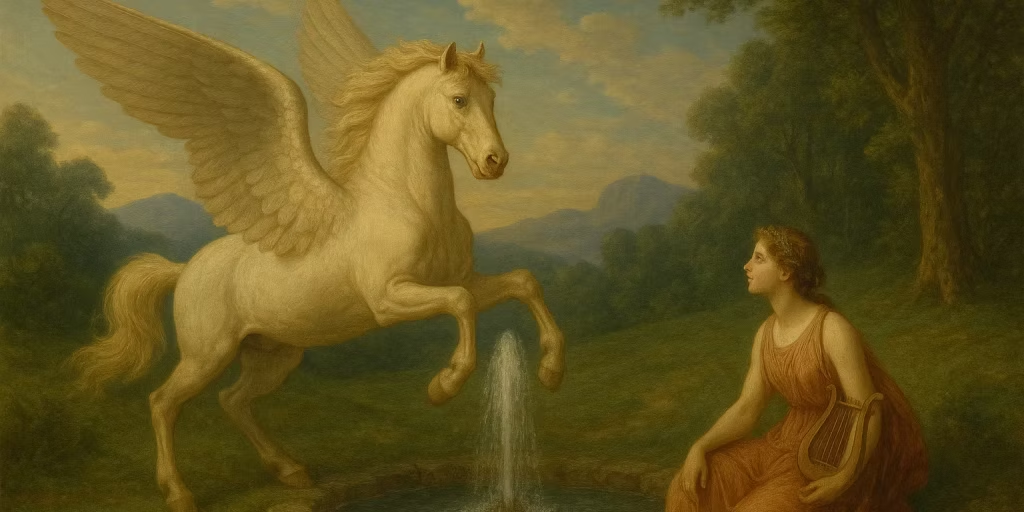
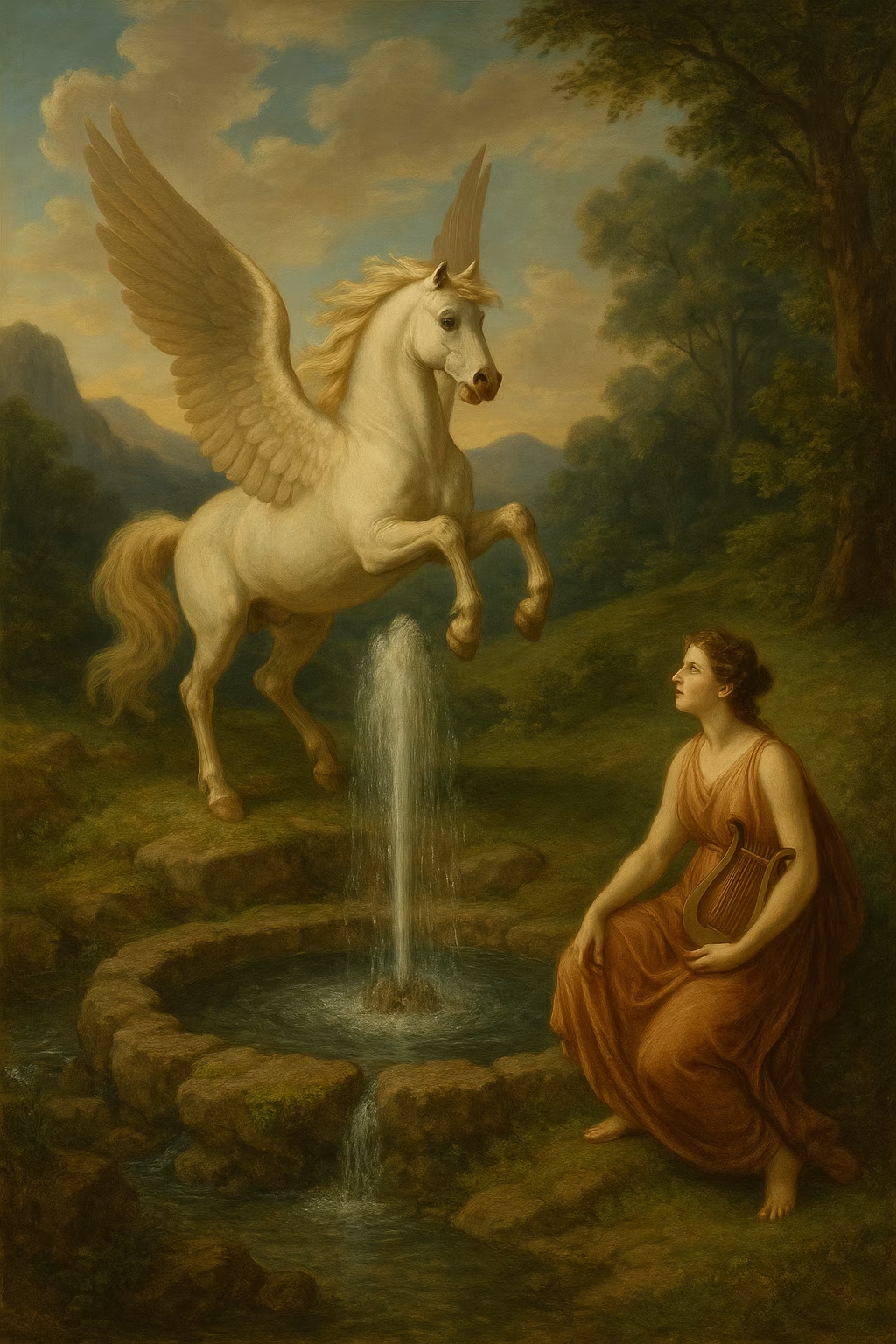
It all began with Pegasus. This fascinating creature, born from Medusa’s blood after she was beheaded by the hero Perseus, was not merely a winged horse: it was a divine creature, a being between the earthly and celestial worlds. Its very existence defied natural laws, and its presence was charged with symbolic meaning. According to legend, Pegasus flew to Mount Helicon —one of the favorite dwellings of the Muses— and, when its hoof touched the ground, a spring burst forth: Hippocrene, whose name literally means “the horse’s spring.”
This act was no accident. In the Greek worldview, places were not merely settings but living entities charged with meaning. That Pegasus caused a spring to burst forth was not only a natural miracle but a gesture laden with symbolic power: the celestial horse, linked to the sky and to elevated thought, gave the earth a source of inspiration.
The Muses and the Sacredness of Helicon
The Guardians of Art
It is no coincidence that the Hippocrene spring was located on Mount Helicon, one of the sacred dwellings of the Muses. These daughters of Zeus and Mnemosyne (Memory) were nine in number, and each presided over one of the arts and sciences: from epic and lyric poetry to dance, history, and astronomy. They were, in short, the personifications of human creativity guided by the divine.
Helicon, covered in forests and bathed by springs, was considered a space of pure harmony. There, the Muses danced, sang, and bestowed their gift upon chosen mortals. But the Hippocrene spring held a central place in this setting: it was the core of that creative energy, the place poets and artists turned to —in body or in spirit— to receive the gift of eloquence, imagination, and genius.
Drinking from the Spring of Poetry
The spring was not merely sacred: it was active. According to tradition, drinking its waters or simply approaching it allowed a poet to receive the furor poeticus, the divine madness that inspires immortal verses. Hesiod, one of the earliest Greek poets, mentions in his Theogony how the Muses granted him the gift of song after encountering him while he was tending sheep. This detail illustrates how, in the Greek mindset, inspiration was not the fruit of rational effort but of an encounter with the sacred.
For this reason, the Hippocrene spring was not merely a symbol of fertility or natural beauty: it was the liquid personification of poetic grace. It was the channel through which the divine poured into the human, the exact point where word and spirit met.
The Deep Symbolism of Hippocrene
Creativity as a Divine Gift
In an era when poetry and art were vehicles of truth and revelation, the concept of a literal spring of inspiration carried enormous symbolic weight. Hippocrene was not simply a spring, but a reminder that true creativity does not arise solely from technique or study, but from contact with the numinous, with that which lies beyond reason.
Hence Pegasus —a symbol of the aerial, the elevated, that which flies above the mundane— is the creator of this spring. The message is clear: true artistic creation does not crawl, but flies. It is not produced at ground level, but descends from the heights of the soul or the cosmos.
Nature and Art: A Sacred Alliance
The way the spring bursts from the ground upon contact with Pegasus’s hoof also speaks to a deeper truth: art and nature are not opposites, but allies. The earth is not merely raw matter, but holds within it spiritual potential waiting to be released. Art, then, would be nothing more than the act of revealing what already lies latent in the natural world.
This view contrasts with other cultural traditions where creativity is seen as a struggle against chaos or an imposition of form upon matter. In the Greek case, the Hippocrene spring suggests that inspiration exists within the world, and that the artist is one who knows how to listen to its flow.
Hippocrene in Cultural Tradition
From Ovid to the Renaissance
The symbolic power of Hippocrene did not fade with antiquity. In Ovid’s Metamorphoses, the spring appears once again as a meeting point between gods and men, as a channel of spiritual transformation. The Roman poet mentions it when invoking the Muses at the beginning of his work, showing that even centuries after Hesiod, the spring remained a living metaphor.
During the Renaissance, amid the rediscovery of classical culture, the Hippocrene spring regained prominence. Poets such as John Milton and Edmund Spenser alluded to it in their works, seeing in its waters a way to connect with the Greek artistic ideal. In this period, drinking from Hippocrene was synonymous with drinking from the classical canon, with aspiring to a universal beauty.
Depictions in Visual Art
But literature was not alone in celebrating Hippocrene. Visual art also embraced its imagery. In Roman mosaics, medieval frescoes, or Renaissance paintings, we find depictions of Pegasus striking the earth, of Muses dancing beside the spring, of poets kneeling in search of its blessing.
These works do not merely illustrate a myth; they take part in it: by depicting it, they reactivate it. Thus, the Hippocrene spring has inspired not only verses, but also brushstrokes, sculptures, musical compositions, and even philosophical discourses on the nature of creation.
A Legacy That Still Flows
The Hippocrene spring is not just a beautiful myth: it is a powerful idea about what it means to create. It is an invitation to recognize that inspiration can come from the highest heights, but can also well up from the deepest depths. That art is not an industrial product, but a communion between human beings, nature, and the sacred.
In a world like today’s, where productivity is often valued more than contemplation, the myth of Hippocrene reminds us that creativity needs sacred spaces, slow time, and deep connections. That perhaps, to find our own words, we must go back to searching for our own springs.
And although we cannot fly like Pegasus, nor literally drink from a mythical spring, we can draw near to those places —physical or symbolic— where the soul rises, where words flow, where art is born without effort, like water bursting from the earth. It is not merely a beautiful myth, but a representation of how the ancient Greeks understood inspiration and art: as divine gifts that connect human beings with the transcendent. The story of Pegasus and the spring continues to remind us that authentic creativity springs from the deepest part of nature and the human soul, a legacy that still inspires artists and dreamers around the world today.
Subscribe
If you want to receive stories, curiosities, and legends of the most fascinating creatures of classical mythology in your inbox, just fill out this form.
Continue reading
If you liked this article, you like mythology. And in this case, we have much more to offer you. Discover new adventures, heroes, nymphs, gods, battles, teachings… Just click on the button.
The Revenge of Clytemnestra
The queen of Mycenae, Clytemnestra, stands as one of the most intriguing and complex figures in Greek mythology. Her story, which has been explored in literature and art over the centuries, is a saga of love, betrayal, revenge, and tragedy. In this article, we will...

The Gorgons, the Three Monstrous Sisters
In the vast array of mythological beings that inhabit the legends of ancient Greece, the Gorgons hold a particularly terrifying place. These female beings, whose name comes from the ancient Greek word "gorgós," meaning "fierce" or "terrible," are famous mainly for...

Iris, the Messenger of the Gods
Greek mythology, rich in stories, characters, and symbolism, has fascinated humanity for thousands of years. Among the gods and goddesses who populate these stories, one figure stands out for her connection to the sky, the gods, and humans: Iris, the messenger of the...

Who Was Tyndareus?
Greek mythology is a vast universe full of stories and characters that have influenced Western culture in countless ways. Among these characters, one of the most important is Tyndareus, king of Sparta. His life, full of intrigue and conflict, is a perfect example of...

Cadmus, the Phoenician Hero
In the tales of Greek mythology, we find countless characters who have left their mark on history and culture. Among them, a figure who stands out is Cadmus, the Phoenician hero who became the legendary founder of the city of Thebes. In this article, we will explore...

The Curse of Phaedra
In the vast cosmos of Greek mythology, Phaedra represents a luminous and tragic figure. Her name is synonymous with forbidden passion, deceit, and revenge, and her story has inspired generations of playwrights, novelists, and psychologists. In this article, we will...

The Myth of Ixion
In the following article, we will explore the myth of Ixion, his story, and the impact he has had on Greek culture and beyond. Greek mythology is full of colorful characters and impressive adventures. Its pages are adorned with tales of love, betrayal, courage, and...

What Are Greek Tragedies?
Greek tragedies are a form of theater that originated in ancient Greece. The tragic and moving stories these dramas present have captivated audiences for thousands of years. In this article, we'll explore the history, characters, themes and legacy of Greek tragedies....

Monstruos femeninos en la mitología griega
La mitología griega está repleta de criaturas extraordinarias que han cautivado la imaginación de generaciones. Dentro de estas criaturas, los monstruos femeninos tienen un rol específico, simbolizando fuerzas originarias y encarnando miedos antiguos. Estas entidades,...

mitologiaclasica.com is a website dedicated to exploring and popularizing the fascinating richness of mythology, offering a vast compendium of stories, characters, and legends.
Explore
Greek Mythology
Roman Mythology
Norse Mythology
Egyptian Mythology
Hindu Mythology
Chinese Mythology
Japanese Mythology
Celtic Mythology
Privacy Policy
Privacy Policy
Copyright mitologiaclasica.com