Greek mythology is a vast mosaic of gods, heroes, and legendary entities, each with its own narrative and singular character. One of these gods is Nereus, an ancient sea deity who, although less well known than Poseidon, plays an important role in the Greek pantheon. This article will examine his figure, from his origin in the divine genealogy to his impact on astronomy and the stars.
The Ancient Sea Deity: Nereus
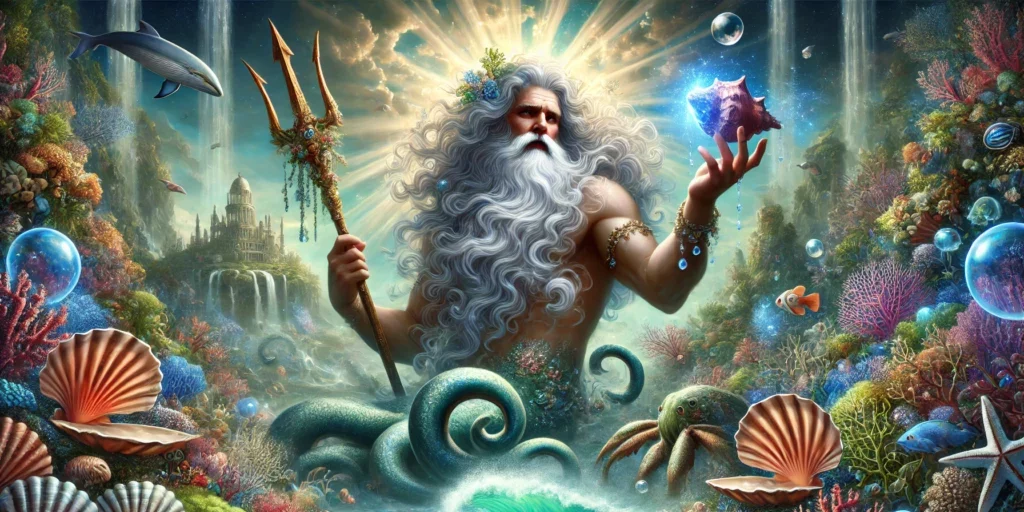
Nereus is not a name frequently heard when discussing Greek mythology, but his role and relevance in this rich pantheon are unquestionable. This god, also called the “Old Man of the Sea,” belongs to the original marine deities of ancient Greece. He was respected as the servant of the sea, with the ability to change his appearance and foresee the future.
Unlike the stormy, tempestuous image often associated with marine deities, he was famous for his wisdom and peaceful nature. As god of the sea, his domain extended over the rich depths of the ocean, but he was also a symbol of fishing and was associated with fertility and abundance.
In addition to his role as god of the sea, he was also the father of the Nereids, the fifty sea nymphs of Greek mythology. His wife, Doris, was also a sea goddess, and together they formed an inseparable bond with the aquatic world.
Who Was Nereus in Greek Mythology?
In Greek mythology, Nereus is considered one of the oldest deities. He was known as the “Old Man of the Sea” because he was believed to be the oldest god of the sea, even older than Poseidon. This title was also due to his wisdom and knowledge of all things, as he was said to have the gift of prophecy.
He did not have the furious, violent personality often attributed to sea gods; instead, he was wise, just, and benevolent. This is reflected in his role as god of fishermen, as he offered them safe sailing and abundant catches.
The Divine Genealogy: Nereus’s Parents and Siblings
Nereus’s genealogy is a veritable who’s who of Greek mythology. Son of the Titans Pontus and Gaia, Nereus is one of the oldest sea gods. He has several siblings, including Thaumas, Phorcys, Ceto, and Eurybia, all of them important marine deities.
The god Nereus belongs to the generation of the Titans, the ancient gods who ruled the world before being overthrown by the Olympian gods. As such, he is a link between the oldest marine deities and the younger generation of gods and goddesses.
Although Nereus and his siblings are less well known than the Olympian gods, they play an important role in Greek mythology. Through his descendants, such as the Nereids, they have left an indelible mark on Greek culture.
The Marriage of Nereus and Doris
Nereus was married to Doris, a sea nymph and one of the daughters of Oceanus and Tethys. Together they had fifty daughters, the Nereids, and one son, Nerites. This marriage represented the union of the oldest marine deities, and reinforced Nereus’s connection to the sea.
Doris, like her husband, was kind and peaceful. Together, they represented the beauty and serenity of the sea, far from the image of storm and fury often associated with marine deities. Their marriage is an example of how the ancient Greeks viewed the sea: a place of abundance and fertility, but also of mystery and change.
The fifty daughters of Nereus and Doris, the Nereids, were sea nymphs known for their beauty. They are often depicted accompanying their father on his sea voyages, and play an important role in several stories and legends of Greek mythology.
The Nereids: Nereus’s Daughters and Their Role in Mythology
The Nereids, daughters of Nereus and Doris, are a group of fifty sea nymphs who play an important role in Greek mythology. They were credited with supernatural beauty, and were believed to have the ability to change their form, just like their father. The Nereids were benevolent and kind, and often helped sailors in danger.
One of the most famous is Thetis, the mother of Achilles. In the Iliad, it is described how Thetis goes to her father for advice on how to help her son during the Trojan War.
The Nereids also play a prominent role in the story of Perseus and Andromeda. When Andromeda’s mother, Cassiopeia, boasts that her daughter is more beautiful than the Nereids, the sea nymphs are offended and send a sea monster to punish the city. Perseus eventually rescues Andromeda and kills the monster.
The Prophetic “Old Man of the Sea”
In addition to being known as the “Old Man of the Sea,” Nereus was also famous for his prophetic abilities. He was said to have the gift of foreseeing the future and of changing shape, and often used these abilities to confuse and evade those who sought his prophecy.
In the Iliad, Achilles seeks out Nereus to obtain a prediction about the outcome of the Trojan War. Nereus, however, transforms into different sea creatures to avoid Achilles. Eventually, Achilles manages to catch Nereus, who finally gives in and prophesies the end of the war.
Heracles, in his quest for the apples of the Hesperides, also consults Nereus. As with Achilles, Nereus tries to evade him by changing shape, but the hero eventually manages to catch him and obtain the information he needs.
The Relationship Between Nereus and Poseidon: A Clash of Sea Titans
Although Nereus and Poseidon are both gods of the sea, their relationship is one of mutual respect rather than rivalry. Poseidon, the Olympian god of the sea, is younger and more famous than Nereus, but respects the wisdom and knowledge of the Old Man of the Sea.
Poseidon has a violent, stormy temperament. However, in several stories, he seeks Nereus’s advice and respects his wisdom. In addition, both are also connected through the figure of the Nereids. The most famous of the Nereids, Thetis, is the mother of Achilles, whom Poseidon helps on several occasions during the Trojan War.
Ancient Literature: References and Appearances
As a mythological figure, Nereus has a prominent role in several ancient literary works. In Homer’s “Iliad,” he is an old man of the sea respected and venerated by the other gods. In the “Odyssey,” he is mentioned for his wisdom and knowledge of the seas. He also appears in Ovid’s “Metamorphoses,” where he is a respected old man with the power to change shape and prophesy.
He is also often mentioned in ancient poetry, where his function as a sea god and his attributes of wisdom and justice are frequently praised. For example, in Hesiod’s “Theogony”, he appears as a just being who always tells the truth.
Finally, he is also part of the “Argonautica” of Apollonius of Rhodes, where he is credited with helping the Argonauts in their quest for the Golden Fleece. In this work, Nereus uses his prophetic power to help the heroes on their journey.
Influence on Greek and Roman Art
Greek and Roman art also reflects the importance of Nereus. In Greek pottery, he is depicted as an old man of the sea with a crown of seaweed branches. In sculpture, he is usually depicted as an old, bearded man, sometimes accompanied by Nereids, the sea nymphs who are his daughters.
In Roman art, he has a less frequent but still significant presence. He appears in mosaics, frescoes, and sculptures, where he is often depicted in mythological scenes related to the sea. In some depictions, he is shown as the father of the Nereids, underscoring his importance in sea mythology.
He is also found on some Roman coins, where his image is used to symbolize the wealth and abundance of the sea. This reinforces his role as god of the riches of the sea and shows the importance of his cult in ancient Rome.
Connection to Astrology and the Stars
In ancient Greece, it was believed that the gods had a direct influence on celestial bodies and that their will could be interpreted through the movements of the stars.
This is why, as a god of the sea, he is often associated with the constellation Pisces. This constellation, which represents two fish, is considered a symbol of the sea’s abundance and is often associated with wealth and prosperity.
In addition, in Greek astrology, he is often associated with the qualities of wisdom, justice, and prophecy. These traits are reflected in people born under the sign of Pisces, who are said to be intuitive, fair, and wise.
Resurgence and Interpretations
In modern times, Nereus has experienced a resurgence and has been reinterpreted in various forms of art and literature. In modern literature, for example, he is depicted as a symbol of wisdom and justice in a chaotic world.
In art, on the other hand, he is often used to symbolize the power and majesty of the sea. His modern depictions often highlight his role as the wise old man of the sea and god of the sea’s riches.
Finally, in modern astrology, he is associated with the constellation Pisces and the qualities of wisdom, justice, and prophecy. His figure remains a source of inspiration and symbolism for many people today.
His Impact on Greek Culture
Despite his underrated role in Greek mythology, Nereus has had a significant impact. His presence in ancient literature, art, and astrology demonstrates his importance. His figure highlights the Greeks’ connection to the sea and their belief in the power of wisdom and justice.
Finally, the resurgence and modern reinterpretations of Nereus demonstrate his continued relevance. His figure remains a source of inspiration and symbolism, showing that he holds an important place in Greek mythology and culture.

Subscribe
If you want to receive stories, curiosities, and legends of the most fascinating creatures of classical mythology in your inbox, just fill out this form.
Continue reading
If you liked this article, you like mythology. And in this case, we have much more to offer you. Discover new adventures, heroes, nymphs, gods, battles, teachings… Just click on the button.
The Revenge of Clytemnestra
The queen of Mycenae, Clytemnestra, stands as one of the most intriguing and complex figures in Greek mythology. Her story, which has been explored in literature and art over the centuries, is a saga of love, betrayal, revenge, and tragedy. In this article, we will...

The Gorgons, the Three Monstrous Sisters
In the vast array of mythological beings that inhabit the legends of ancient Greece, the Gorgons hold a particularly terrifying place. These female beings, whose name comes from the ancient Greek word "gorgós," meaning "fierce" or "terrible," are famous mainly for...

Iris, the Messenger of the Gods
Greek mythology, rich in stories, characters, and symbolism, has fascinated humanity for thousands of years. Among the gods and goddesses who populate these stories, one figure stands out for her connection to the sky, the gods, and humans: Iris, the messenger of the...

Who Was Tyndareus?
Greek mythology is a vast universe full of stories and characters that have influenced Western culture in countless ways. Among these characters, one of the most important is Tyndareus, king of Sparta. His life, full of intrigue and conflict, is a perfect example of...

Cadmus, the Phoenician Hero
In the tales of Greek mythology, we find countless characters who have left their mark on history and culture. Among them, a figure who stands out is Cadmus, the Phoenician hero who became the legendary founder of the city of Thebes. In this article, we will explore...

The Curse of Phaedra
In the vast cosmos of Greek mythology, Phaedra represents a luminous and tragic figure. Her name is synonymous with forbidden passion, deceit, and revenge, and her story has inspired generations of playwrights, novelists, and psychologists. In this article, we will...

The Myth of Ixion
In the following article, we will explore the myth of Ixion, his story, and the impact he has had on Greek culture and beyond. Greek mythology is full of colorful characters and impressive adventures. Its pages are adorned with tales of love, betrayal, courage, and...

What Are Greek Tragedies?
Greek tragedies are a form of theater that originated in ancient Greece. The tragic and moving stories these dramas present have captivated audiences for thousands of years. In this article, we'll explore the history, characters, themes and legacy of Greek tragedies....

Monstruos femeninos en la mitología griega
La mitología griega está repleta de criaturas extraordinarias que han cautivado la imaginación de generaciones. Dentro de estas criaturas, los monstruos femeninos tienen un rol específico, simbolizando fuerzas originarias y encarnando miedos antiguos. Estas entidades,...

mitologiaclasica.com is a website dedicated to exploring and popularizing the fascinating richness of mythology, offering a vast compendium of stories, characters, and legends.
Explore
Greek Mythology
Roman Mythology
Norse Mythology
Egyptian Mythology
Hindu Mythology
Chinese Mythology
Japanese Mythology
Celtic Mythology
Privacy Policy
Privacy Policy
Copyright mitologiaclasica.com