Greek mythology is full of astonishing stories that have left an indelible mark on culture and art over the centuries. One of the most intriguing and controversial tales is that of “Leda and the Swan.” The story of the seduction of the mortal Leda by the god Zeus disguised as a swan is a point of discussion both for its sexual content and for its implications regarding the role of the gods in the lives of human beings. This article explores the mythology of Leda and the swan in depth, its influence on Greek culture, and how it has been depicted in art and literature.
“Leda and the Swan”: A Mythological Journey
The story of Leda and the swan is one of the most intriguing in Greek mythology. Leda is famous for being the mother of the divine twins Castor and Pollux (the Dioscuri) and the twin sisters Helen of Troy and Clytemnestra. But her story is much more than that of a mother of gods and heroes. It is a story of seduction, deceit, and manipulation by Zeus, king of the gods.
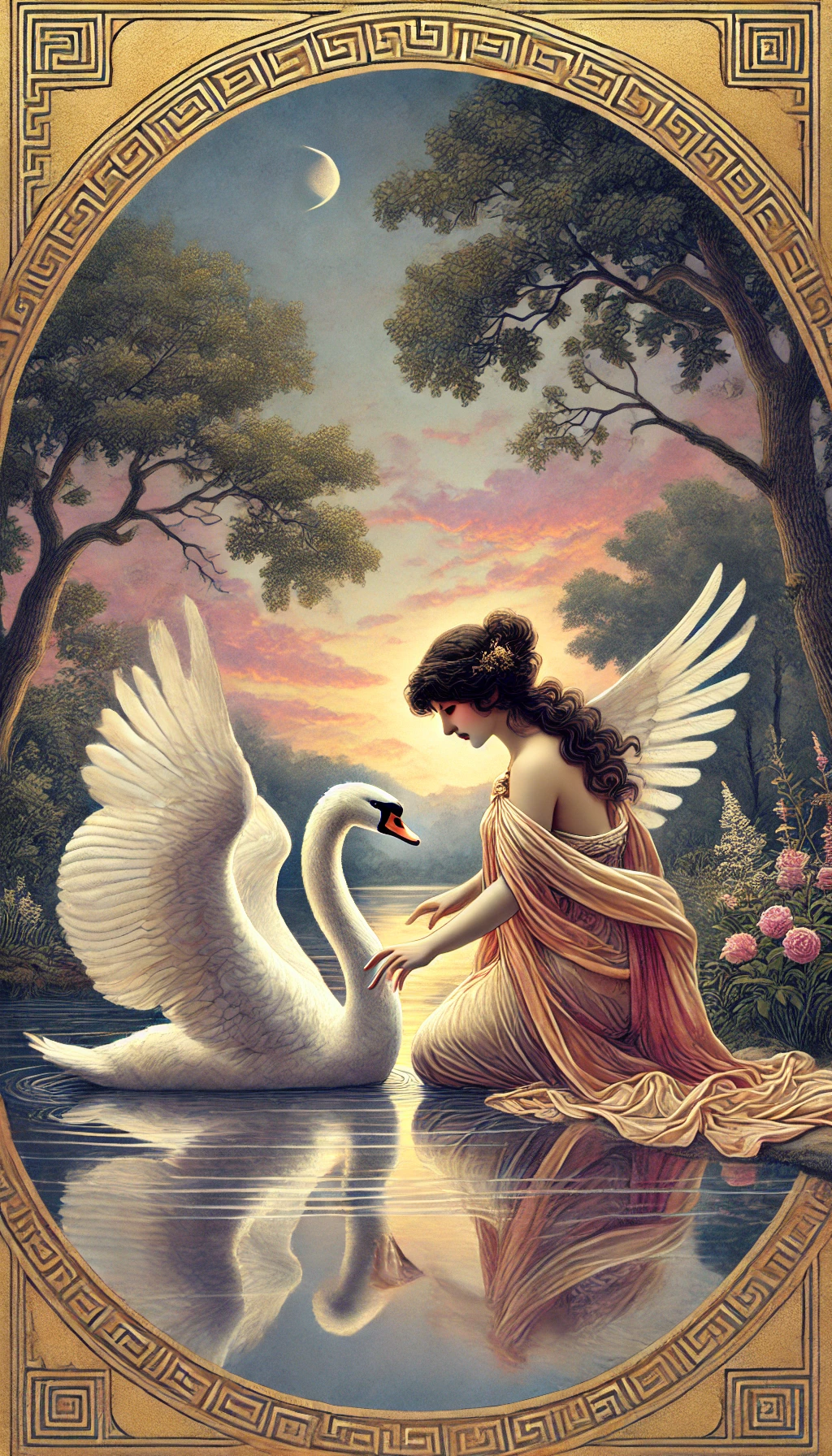
Zeus, famous for his countless infidelities to his wife Hera, became interested in Leda, the beautiful queen of Sparta. Knowing he could not seduce her as a god, he took the form of a beautiful, majestic swan. Disguised as a swan, he thus deceived Leda and seduced her.
The story of Leda and the swan highlights the omnipotence of the gods in Greek mythology and their role in the lives of mortals.
Zeus and Leda: The Swan Incarnation and Seduction
Zeus, king of the gods, was known for his constant infidelities, and transformation was one of his favorite tactics for deceiving mortal women. In Leda’s case, Zeus took the form of a swan to attract and ultimately seduce the queen of Sparta.
Within Greek mythology, Zeus’s transformations are representative of his power and cunning. By taking the form of a swan, Zeus not only attracted Leda through its majestic beauty, but also projected an image of vulnerability that caused her to let her guard down.
Leda’s seduction represents the imposition of the gods over mortals, highlighting the power imbalance and manipulation that characterize many of the relationships between gods and humans in Greek mythology.
The Role of the Gods in Greek Mythology
In Greek mythology, the gods play a crucial role. They are omnipotent, omnipresent, and immortal. Their power over mortals is clearly represented in the story of Leda and the swan. Zeus, the supreme god, can take any form he wishes and manipulate mortals to satisfy his desires.
However, although the gods have total control, they are also limited by their own passions and desires. In Zeus’s case, his lust led him to take the form of a swan, which resulted in a series of events that would change the course of mythological history.
The story of Leda and the swan also highlights the role of the gods as creators and destroyers, capable of changing mortals’ lives on a simple whim.
The Spartan Queen Caught in Zeus’s Net
Leda, the woman at the center of this famous myth, was a queen of Sparta known for her beauty. When Zeus saw her, he was instantly captivated and decided to seduce her. However, to do so, he had to resort to cunning and took the form of a swan.
Unable to resist the beauty and apparent vulnerability of the swan, Leda allowed herself to be seduced by Zeus. This act resulted not only in the conception of four children, two of whom were immortal, but also placed Leda in a position of danger and scrutiny.
Leda’s role in this myth highlights the vulnerability and subjugation of mortals before the gods. Despite her status as queen, she is powerless before Zeus’s power and cunning.
The Duality of Leda’s Figure in Mythology
The figure of Leda in Greek mythology presents an interesting duality. On one hand, she is a victim, deceived and manipulated by Zeus, who takes advantage of her innocence and goodness. On the other hand, she is a powerful and venerated mother, the only known mortal to give birth to both mortal and immortal children.
This duality highlights both Leda’s fragility and her strength. Although she is seduced and deceived by Zeus, Leda is not simply a victim. She is a woman who, despite the circumstances, maintains her dignity and strength, giving birth to children who will become important figures in Greek mythology.
This story shows how women in Greek mythology, despite being used and manipulated by the gods, can emerge with significant power and influence.
Interpreting the Union Between Zeus and Leda
The union between Zeus and Leda is one of the most debated and analyzed aspects of the story. Some interpret this encounter as an act of violence and domination by Zeus, while others see it as a consensual seduction.
In any case, what is indisputable is the power imbalance inherent in the relationship. Zeus, as supreme god, has total control over the situation, while Leda, as a mortal, has few options.
The interpretation of this union also varies depending on the cultural context and the era in which the story is depicted. Over the centuries, the story has been used to explore themes such as power, seduction, manipulation, and subjugation.
Leda’s Children: The Dioscuri and Their Sisters
As a result of the union between Zeus and Leda, four children were born: the Dioscuri, also known as the divine twins Castor and Pollux, and the twin sisters Helen of Troy and Clytemnestra. These children are as famous as their parents and are central figures in many Greek myths.
The Dioscuri are venerated as heroes and gods. Castor, a mortal, was known for his skill as a horse tamer, while Pollux, an immortal, was a formidable boxer. According to mythology, after Castor’s death, Pollux shared his immortality with him, and both now spend half their time on Olympus and the other half in the underworld.
Helen and Clytemnestra, on the other hand, are more controversial figures. Helen is best known as the cause of the Trojan War, while Clytemnestra is famous for orchestrating the murder of her husband, Agamemnon.
The Impact of Leda’s Story on Greek Culture
The story of Leda and the swan has had a great impact on Greek culture. Not only has it given rise to many myths, but it has also influenced how the Greeks understood the role of the gods in their lives.
The story is a clear illustration of how the gods can manipulate and control the lives of mortals. It also highlights the power imbalance between gods and humans and the role of women in Greek society.
The story has also influenced how we understand myth and legend today. Many modern interpretations of Greek mythology are based on the relationship between Leda and Zeus and the consequences of their union.
The Influence of ‘Leda and the Swan’ on Art
Many artists, from antiquity to modern times, have found inspiration in this myth. The story has been depicted in paintings, sculptures, engravings, and much more.
The erotic and violent nature of the story has led to many controversial depictions, especially in more conservative eras. However, it has also allowed artists to explore themes of power, seduction, and manipulation.
Among the most famous artists who have depicted the story of Leda and the swan are Leonardo da Vinci, Michelangelo, and Peter Paul Rubens, whose interpretations of the story have been analyzed and debated over the centuries.
Multiple Depictions in Literature
As in art, the story of ‘Leda and the Swan’ is a popular subject in literature throughout the centuries. From ancient Greece to modern literature, the story of Leda has been reinterpreted and reimagined countless times.
The story has been used to explore themes of power, violence, seduction, and deceit. Many authors have used the figure of Leda to explore the female condition and gender roles, as well as the relationship between mortals and gods.
Among the most notable writers who have explored this story are William Butler Yeats, whose poem ‘Leda and the Swan’ is one of the most famous interpretations of the story, and Alfred Tennyson, whose poem ‘Leda’ also explores the myth.
Reflections on Power and Violence
The story of Leda and the swan is a powerful reflection on power and violence. Through the figure of Zeus, the story reveals the ability of the powerful to impose their will on the less powerful.
Leda’s role also serves to illustrate the violence inherent in power imbalance. It also highlights the moral ambiguity of the Greek gods, who, despite being supreme beings, are not above acts of violence and manipulation.
A Story of Manipulation and Deceit
The story of ‘Leda and the Swan’ is one of the most famous stories in Greek mythology. It reveals the cunning and power of the gods, as well as their ability to manipulate and control mortals. However, it also highlights the resilience and dignity of mortals in the face of adversity.
Despite the manipulation and deceit, Leda gives birth to four children who will become important figures in Greek mythology. Thus, despite the challenges, she emerges as a figure of strength and resilience.
Subscribe
If you want to receive stories, curiosities, and legends of the most fascinating creatures of classical mythology in your inbox, just fill out this form.
Continue reading
If you liked this article, you like mythology. And in this case, we have much more to offer you. Discover new adventures, heroes, nymphs, gods, battles, teachings… Just click on the button.
The Revenge of Clytemnestra
The queen of Mycenae, Clytemnestra, stands as one of the most intriguing and complex figures in Greek mythology. Her story, which has been explored in literature and art over the centuries, is a saga of love, betrayal, revenge, and tragedy. In this article, we will...

The Gorgons, the Three Monstrous Sisters
In the vast array of mythological beings that inhabit the legends of ancient Greece, the Gorgons hold a particularly terrifying place. These female beings, whose name comes from the ancient Greek word "gorgós," meaning "fierce" or "terrible," are famous mainly for...

Iris, the Messenger of the Gods
Greek mythology, rich in stories, characters, and symbolism, has fascinated humanity for thousands of years. Among the gods and goddesses who populate these stories, one figure stands out for her connection to the sky, the gods, and humans: Iris, the messenger of the...

Who Was Tyndareus?
Greek mythology is a vast universe full of stories and characters that have influenced Western culture in countless ways. Among these characters, one of the most important is Tyndareus, king of Sparta. His life, full of intrigue and conflict, is a perfect example of...

Cadmus, the Phoenician Hero
In the tales of Greek mythology, we find countless characters who have left their mark on history and culture. Among them, a figure who stands out is Cadmus, the Phoenician hero who became the legendary founder of the city of Thebes. In this article, we will explore...

The Curse of Phaedra
In the vast cosmos of Greek mythology, Phaedra represents a luminous and tragic figure. Her name is synonymous with forbidden passion, deceit, and revenge, and her story has inspired generations of playwrights, novelists, and psychologists. In this article, we will...

The Myth of Ixion
In the following article, we will explore the myth of Ixion, his story, and the impact he has had on Greek culture and beyond. Greek mythology is full of colorful characters and impressive adventures. Its pages are adorned with tales of love, betrayal, courage, and...

What Are Greek Tragedies?
Greek tragedies are a form of theater that originated in ancient Greece. The tragic and moving stories these dramas present have captivated audiences for thousands of years. In this article, we'll explore the history, characters, themes and legacy of Greek tragedies....

Monstruos femeninos en la mitología griega
La mitología griega está repleta de criaturas extraordinarias que han cautivado la imaginación de generaciones. Dentro de estas criaturas, los monstruos femeninos tienen un rol específico, simbolizando fuerzas originarias y encarnando miedos antiguos. Estas entidades,...

mitologiaclasica.com is a website dedicated to exploring and popularizing the fascinating richness of mythology, offering a vast compendium of stories, characters, and legends.
Explore
Greek Mythology
Roman Mythology
Norse Mythology
Egyptian Mythology
Hindu Mythology
Chinese Mythology
Japanese Mythology
Celtic Mythology
Privacy Policy
Privacy Policy
Copyright mitologiaclasica.com