The rich and fascinating mythology of China is full of gods and goddesses, mythological heroes and supernatural creatures. Among these numerous figures, the goddess Houtu holds a special place. As goddess of the Earth, she is said to have the power to nurture all life on earth. But who was she really, and what is her role in mythology? Join us on this journey through Chinese history and culture to find out.
Getting to know Houtu, the goddess of the Earth in Chinese mythology
The Chinese pantheon is full of gods and goddesses, each with their own set of abilities and responsibilities. Among these, Houtu, the goddess of the Earth, is a prominent figure. She is believed to have the power to nurture all life on earth, a powerful figure who personifies Mother Nature in Chinese mythology.
Houtu is worshipped not only as goddess of the Earth, but also as a deity of fertility, agriculture and motherhood. Her influence is believed to extend to all things that grow and develop on earth, from crops to children.
The goddess Houtu is also known as the “Queen of the Earth”, and her figure appears in many Chinese stories and legends. Her importance in mythology is not limited only to her function of nurturing earthly life, but is also associated with justice and wisdom.
The imposing goddess of the Earth in China
Houtu is considered one of the most powerful goddesses in Chinese mythology. As goddess of the Earth, she is seen as the one responsible for maintaining order and harmony in the world. Her power is such that she is considered capable of changing the course of rivers and moving mountains.
She is also the mother of all living things on earth. Her love and care for all living creatures is said to be immense, and she is always ready to protect and nurture life on earth.
In addition to her role as goddess of the Earth, Houtu is also venerated as the goddess of fertility. She is believed to have the power to promote fertility, both in people and in crops. This belief has made her a very popular figure among Chinese women, especially those who wish to have children.
Who was Houtu? Discovering her legend
The legend of Houtu is a fascinating story full of mystery. According to Chinese mythology, Houtu was initially a human who later became a goddess. It is said that during the ancient Xia dynasty, Houtu was the empress who ruled with wisdom and justice.
It is said that she was the one who introduced writing to human beings and established laws to maintain order in society. For her wisdom and justice, she was worshipped by her people and eventually ascended to the realm of the gods.
Legend also tells that she was able to change the course of rivers and move mountains to help people. This story serves to illustrate her immense power and her love for humanity.
The relevance of Houtu in Chinese culture and religion
Houtu plays a crucial role in Chinese culture and religion. As goddess of the Earth, she is an important figure in Chinese mythology, and her influence extends to many areas of Chinese life, from agriculture to motherhood.
Worship of Houtu is an integral part of Chinese folk religion. Many people make offerings to her to ask for her blessing on agriculture and fertility. Moreover, her wisdom and justice make her a respected and venerated figure in Chinese society.
A fundamental pillar of Chinese mythology
In her role as goddess of the Earth, Houtu holds a position of great importance in the Chinese pantheon. However, her influence goes beyond her role as goddess. As a figure of wisdom and justice, she is also a role model for many people.
The importance of Houtu in Chinese mythology is reflected in the numerous stories and legends that surround her. These stories serve to illustrate her power and goodness, and are often used to teach valuable lessons.
In addition to her role in mythology, she also holds a prominent place in Chinese folk religion. Many people worship Houtu and make offerings to her seeking blessings and protection.
The strength and wisdom of Houtu, the goddess of the Earth
Houtu is synonymous with strength and wisdom. As goddess of the Earth, she is said to have the power to change the course of rivers and move mountains. This strength speaks not only to her immense power, but also to her role in maintaining order and harmony in the world.
Houtu’s wisdom is also admirable. According to legend, she was the one who introduced writing to human beings and established laws to maintain order in society. Her wisdom and justice make her a figure of worship and respect.
She is also a symbol of goodness and love for all living things. She is said to always be ready to protect and nurture life on earth, making her a maternal figure of reference.
The cult of Houtu: ancestral traditions and rituals
Despite her ancient popularity, worship of Houtu has declined compared to other better-known figures such as Guanyin or the Jade Emperor. However, her legacy persists in many agricultural rituals and local ceremonies in China. In rural areas, farmers still pay tribute to Houtu before planting and harvest seasons, acknowledging their dependence on the earth and natural cycles.
Today, she has also reemerged as a cultural and spiritual symbol in movements seeking to reconnect with ancestral traditions and environmental sustainability. Her figure inspires respect for nature and the understanding that humanity is intrinsically connected to the earth.
There are also festivals celebrated in Houtu’s honor. These festivals often include dances and music, and serve as a way of giving thanks for her protection and blessings.
Dedicated temples: a journey through ancient China
In China, there are numerous temples dedicated to the veneration of Houtu. These temples, many of which date back centuries, are a testament to Houtu’s importance in Chinese culture and religion.
One of the most famous temples is the Houtu Temple in Shanxi province. This temple, built during the Ming dynasty, is known for its magnificent architecture and beautiful murals.
There are also other temples and shrines dedicated to Houtu throughout the country. These places of worship serve as spaces for people to pay tribute to Houtu and seek her blessing and protection.
Symbols and representations in Chinese art
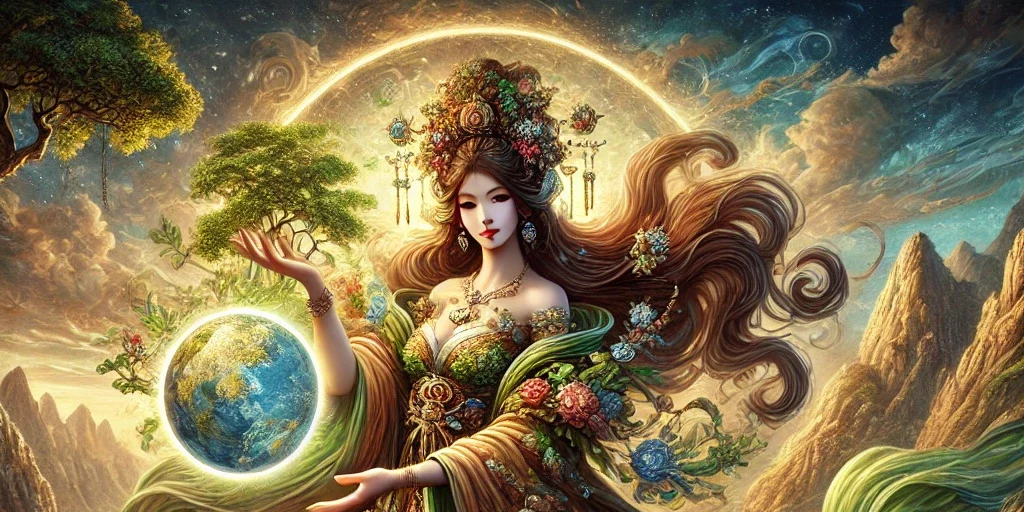
Although the figure of Houtu does not have as specific a visual representation as other deities, her symbolism is omnipresent. At altars and temples, it is common to find offerings of food, earth and water in her honor, reflecting her role as giver of life. Images depicting her usually show a maternal and majestic figure, surrounded by vegetation, animals and elements of nature.
The color yellow, associated with the earth in Chinese tradition, is also linked to Houtu. This color symbolizes not only fertility, but also authority and centrality, reinforcing the goddess’s unique position in the Chinese pantheon.

Subscribe
If you want to receive in your mailbox stories, curiosities and legends of the most fascinating creatures of classical mythology just fill in this form.
Continue reading
If you liked this article, you like mythology. And in this case, we have much more to offer you. Discover new adventures, heroes, nymphs, gods, battles, teachings… Just click on the button.

Bái Zé, Wisdom
Deep within Chinese mythology, lies an extraordinary creature known as Bái Zé. Although it may not be as familiar as the dragon or the phoenix, Bái Zé is equally important in the Chinese mythological pantheon. This creature, according to legend, was an unparalleled...

Fushoulu: Longevity, Fortune and Wealth
Chinese history and culture are famous for their richness in mythology and symbolism. One of the most significant concepts of this tradition is Fushoulu, a triad of deities representing longevity, fortune and wealth. This principle manifests with great intensity in...

I Ching, the Book of Changes
The I Ching, also known as the Book of Changes, is one of the oldest and most respected texts in human history. This Chinese book of wisdom is a guide to life that has been consulted by millions of people seeking guidance and spiritual knowledge. This article explores...
Creation in Chinese Mythology
Mythology is a vast and rich web of legends and stories that has influenced society and culture for thousands of years. These narratives, ranging from creation in Chinese mythology to the founding of dynasties, cover a wide range of themes and provide a fascinating...
Zhong Kui, the king of ghosts
In the vast and intricate world of Chinese mythology, one figure stands out for its peculiar origin and unique role: Zhong Kui, the king of ghosts. Although his physical appearance can be frightening, he is considered a protector and a defender against evil spirits....

Nezha, protector of the innocent
Nezha, a prominent figure in Chinese mythology, is a deity revered and celebrated in Asian culture for his heroic deeds. This figure, who embodies rebellion, love, and protection, has remained relevant over the centuries, strongly influencing the arts, literature, and...
Fenghuang, the Chinese phoenix
The Fenghuang, also known as the Chinese phoenix, is a mythological bird that has played an important role in the country's culture for thousands of years. It represents the union of yin and yang, symbolizing virtue and grace. In addition, there is also a village...
Pangu ,the creator of the world
Pangu is a Chinese mythological figure that plays a fundamental role in Chinese cosmogony. According to legends, Pangu was the creator of the world and his birth marked the beginning of existence. He is also credited with the important task of separating heaven and...

Chinese dragons: Mythical creatures and symbols of power in Chinese culture.
Chinese dragons are legendary creatures of great significance in Chinese culture. Symbols of power and nobility, they have been revered throughout history. With their unique composition, which includes characteristics of various animals, Chinese dragons possess...

mitologiaclasica.com is a website dedicated to explore and spread the fascinating richness of mythology, offering a vast compendium of stories, characters and legends.
Explore
Greek Mythology
Roman Mythology
Norse Mythology
Egyptian Mythology
Hindu Mythology
Chinese Mythology
Japanese Mythology
Celtic Mythology
Privacy Policy
Privacy Policy
Copyright mitologiaclasica.com