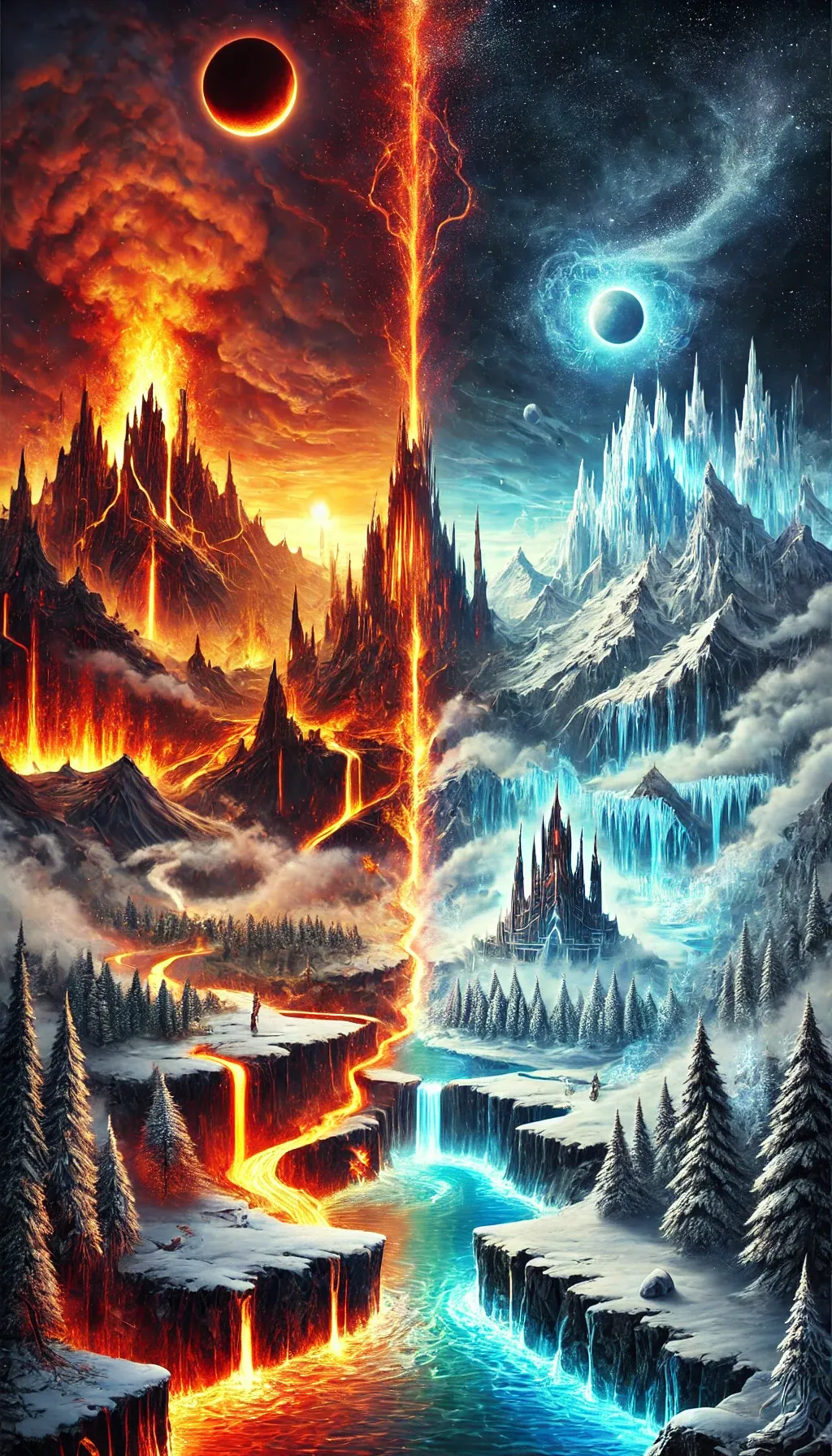
In the mosaic of Norse mythology, two realms stand out for their importance and significance: Muspell and Niflheim. These adjacent realms, one of fire and the other of mist and ice, play fundamental roles in the creation, balance, and end of the universe according to Norse cosmology. Through their symbolism, Muspell and Niflheim teach us profound lessons about opposing poles and the balance of life and death.
The Adjacent Realms: Muspell and Niflheim
Muspell, also known as Muspellheim, is described as a realm of fire, heat, and light, while Niflheim, sometimes called Niflhel, is a world of mist, ice, and darkness. These two realms are adjacent in the sense that they represent opposite extremes in Norse cosmology. In this mythology, the universe is divided into nine worlds, and the adjacent realms are two of them. They are the first to exist, and their interaction is essential to the formation of everything else.
Mythological Origin of the Adjacent Realms
We are dealing with a fascinating mythological origin. According to Norse mythology, before the beginning of time there existed two realms: the fiery Muspell in the south and the freezing Niflheim in the north, separated by the abyss of Ginnungagap. While heat and light reigned in Muspell, Niflheim was a land of darkness, cold, and mist. The intersection of these two opposing forces would give rise to the creation of the universe.
Muspell: The Realm of Fire
Located in the south, Muspell is a realm of eternal flames, incandescence, and destruction. It is the domain of primordial fire, where scorching temperatures and inextinguishable flames reign without ceasing. In this fiery landscape dwells Surtr, the fire giant, whose destiny is to play a crucial role in Ragnarök, the end of times. Surtr, with his flaming sword, will destroy the world in a final conflagration, marking the consummation of the cosmic cycle.
Niflheim: The Realm of Ice and Mist
At the opposite extreme, to the north, lies Niflheim, the realm of cold and darkness. It is a land shrouded in icy mists, full of rivers of frozen poison and deadly waters. At the center of this realm is Hvergelmir, a primordial spring from which icy rivers flow, feeding the abyss of Ginnungagap. Niflheim is also home to Hel, the goddess of death, who rules the underworld where the souls of those who did not die in combat rest.
The Meeting at Ginnungagap
Between Muspell and Niflheim stretches Ginnungagap, the vast primordial abyss, an unfathomable void where nothing existed. However, when the heat of Muspell and the cold of Niflheim met in this void, the ice began to melt, generating drops of water from which Ymir emerged, the first living being, a gigantic and primeval jotun. From his flesh and bones other giants would be born, and later, the gods would use his body to create the world.
The clash between these two opposing realms symbolizes the interaction between the fundamental elements of the cosmos. The fire of Muspell cannot exist without the ice of Niflheim, and vice versa; their fusion and perpetual struggle gave rise to life and the universe according to Norse mythology.
The Location of Muspell and Niflheim in the World Tree, Yggdrasil
In the world tree Yggdrasil, they occupy opposite positions, with Muspell at the highest point and Niflheim at the lowest. Yggdrasil is an immense ash tree that connects the nine worlds of Norse cosmology. The fire giant Surtr, from Muspell, and the serpent Nidhogg, from Niflheim, constantly threaten the stability of Yggdrasil, representing the ever-present danger of the universe’s destruction.
Mythical Beings That Inhabit Muspell and Niflheim
In addition to Surtr and Nidhogg, other mythical beings inhabit Muspell and Niflheim. In Muspell, the fire giants symbolize destruction and the end of all time. In Niflheim, the ice giants or “jotuns,” and the dishonorable dead live in Hel, the realm of death ruled by the goddess Hel, daughter of Loki.
The Prophecy of Ragnarök
In the prophecy of Ragnarök, both Muspell and Niflheim play significant roles. Surtr, the giant of Muspell, will lead a legion of fire giants in the final battle against the gods, while Nidhogg, the serpent of Niflheim, will continue gnawing at the roots of Yggdrasil, hastening the destruction of the world. Both realms contribute to the idea of the inevitable end of the universe.
The Symbolism of Muspell and Niflheim in Norse Mythology
In Norse mythology, Muspell and Niflheim are much more than two opposing realms. They represent the duality of existence, the contrast between heat and cold, light and darkness, life and death, showing that one cannot exist without the other. Through their symbolism, these realms teach us about the importance of balance and interconnection in the universe.
Parallels with Other Mythologies
There are parallels between Muspell and Niflheim and other mythological systems. In many cultures, the duality between fire and ice, light and darkness, life and death is symbolized through opposing regions or deities. In Greek mythology, for example, Tartarus and Elysium can be compared to Niflheim and Muspell, respectively.
The Importance of Muspell and Niflheim in Norse Culture
These realms show us that every aspect of life is necessary to maintain the balance of the universe. Norse mythology remains relevant in our modern culture, and Muspell and Niflheim are perfect examples of how ancient beliefs can continue to influence our conceptions of the world.
They symbolize the opposing poles of existence and play crucial roles in the creation and destruction of the universe. Their presence in contemporary culture demonstrates their relevance and the enduring power of Norse mythology. Through Muspell and Niflheim, we can appreciate the value of duality and balance in our own existence.
Subscribe
If you want to receive stories, curiosities, and legends of the most fascinating creatures of classical mythology in your inbox, just fill out this form.
Continue reading
If you liked this article, you like mythology. And in this case, we have much more to offer you. Discover new adventures, heroes, nymphs, gods, battles, teachings… Just click on the button.

Ginnungagap: What Is the Void in Norse Mythology?
Ginnungagap, a word that seems taken from a science fiction work, is actually an ancient term that means "empty abyss." This deep and enigmatic concept lies at the heart of Norse mythology, representing the primordial empty space that existed before the creation of...

Hymir and the Giant Cauldron
Diving into Norse mythology means exploring a fascinating world of gods, giants, heroes and mystical creatures. Among these, Hymir and the giant cauldron. This giant, famous for his superhuman strength, has a tense relationship with the god Thor. Through the stories...

Mani, the Guardian of the Moon
Norse mythology, full of fascinating characters and mysterious tales, has been a source of inspiration for numerous works of literature, film and music. Within this rich mythological universe, one character who stands out in a special way is Mani, the guardian of the...

Odin, supreme god
Odin god is a central figure in Norse mythology. Considered the supreme god, he was venerated through rituals and festivities in his honor. He was a warrior god and protector of social bonds. He was associated with poetry and inspiration. Odin was described as an old...

The Midgard Serpent: Jörmundgander
The Midgard Serpent is a fearsome creature from Norse mythology. It is known to be the child of Loki and the giantess Angrboða, and dwells in the sea surrounding Midgard, the world of humans. The gods Æsir decided to confront her because of her evil deeds. Thor, one...

What is the name of the hammer of Thor, god of thunder?
Thor, the god of thunder and strength in Norse and Germanic mythology, is a figure of great importance. His influence encompasses different aspects such as weather, fighting and battles. Known for his hammer, called Mjolnir, and his adventures with Loki, he represents...

God Balder: the shining one
The god Balder is a prominent figure in Norse mythology. Known as the god of radiance, Balder is the son of Odin and Frigg. His tragic death at the hands of Loki is one of the most important events in this mythology. In addition to his role in Ragnarok, Balder has...
mitologiaclasica.com is a website dedicated to exploring and popularizing the fascinating richness of mythology, offering a vast compendium of stories, characters, and legends.
Explore
Greek Mythology
Roman Mythology
Norse Mythology
Egyptian Mythology
Hindu Mythology
Chinese Mythology
Japanese Mythology
Celtic Mythology
Privacy Policy
Privacy Policy
Copyright mitologiaclasica.com