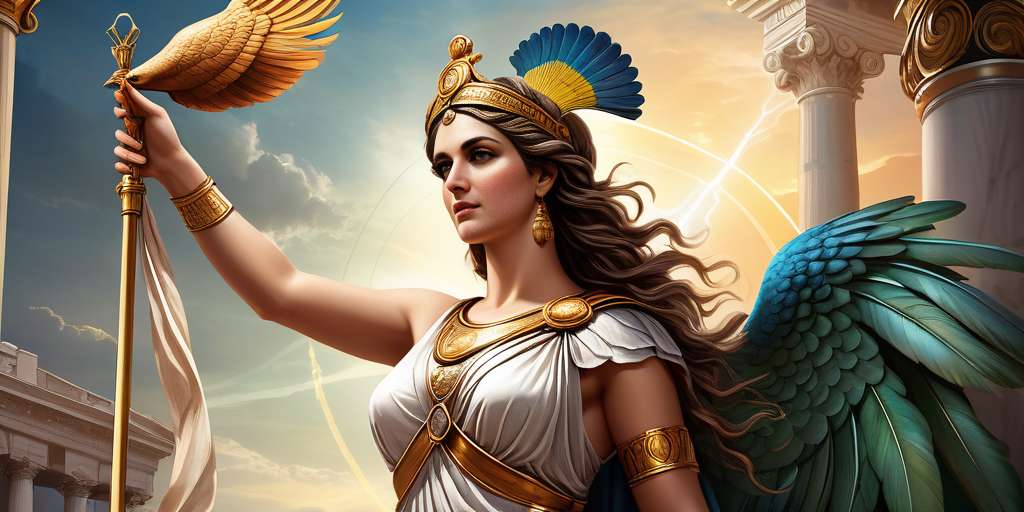
Who is the goddess Juno?
The goddess Juno is a prominent figure in Roman mythology, especially related to the protection of women and feminine aspects. Worshipped along with
She is also linked to the city of Carthage, being identified with the goddess Tanit.
Her relationship with Jupiter was conflictive due to the jealousy it generated.
Curiosities such as her protective role or the symbol of the peacock accompany her.
What is the difference between Hera and Juno?
Juno, one of the most important deities in Roman mythology, plays various roles and is revered for her relationship with women. As a protective goddess, she watches over aspects of female life and is closely associated with love and marriage, as is her Greek counterpart, Hera.
Hera and Juno are equivalents in Greek and Roman mythologies, respectively; Hera is the Greek goddess of marriage, wife of Zeus, known for her jealousy and vengeance against her husband’s mistresses, while Juno, the Roman goddess of marriage and motherhood, is wife of Jupiter and has additional functions related to childbirth and female cycles. Although they share similar attributes, Juno evolved to include more complex characteristics and a prominent role in Roman religion, standing out as part of the Capitoline Triad alongside Jupiter and Minerva.
Juno’s role as protector of women
She is known for her special role as guardian of women. Her protection extends from the daily life of Roman women to her participation in marriage rituals. As the goddess of fertility, Juno is invoked to ensure a happy marriage and the conception of healthy children.
Juno’s association with Minerva and Jupiter in the Roman religion
Juno is one of the deities worshipped along with Jupiter and Minerva on the Quirinal in Rome.
This association is significant, as Juno is both wife and sister of Jupiter, the chief Roman god.
Juno shares her power and divine status with Jupiter, and together they are revered as a sacred force in Roman religion.
Festivities and festivals dedicated to Juno
One of the most prominent festivals is the Matronalia, celebrated on March 1.
During this event, husbands are expected to give gifts to their wives to commemorate the birth of Mars, son of Juno and god of war, and to recognize the fundamental role of women in Roman history.
The different roles and names of Juno
Juno, the goddess of Roman mythology, played several important roles and was known by different names in Roman culture.
These roles and names reflected the different facets of her divinity and her influence on people’s lives.
Juno Sospita: the protector of the incarcerated
One of the names attributed to Juno was Juno Sospita, meaning “the savior.”
As the patron goddess of the imprisoned, Juno was believed to intervene on behalf of those in prison.
The Romans saw her as a divinity who granted protection and defended the rights of captives.
Juno Lucina: the goddess of childbirth
Another name associated with Juno was Juno Lucina, which referred to her role as the goddess of childbirth.
Roman women associated Juno Lucina with protection during the birthing process and she was worshipped to obtain her favor and safeguard the life of mother and child.
Juno Moneta: Goddess of the Moon
Juno Moneta was the name under which Juno was worshipped as the goddess of the moon.
She was believed to oversee the lunar cycle and influence its phases.
In addition, Juno Moneta was related to the financial sphere and was considered the protector and guide of monetary activities in Rome.
Juno’s connection to the city of Carthage
Juno, the Roman goddess of love and marriage, also had a close connection with the ancient city of Carthage.
She was identified with the goddess Tanit, who was worshipped in Carthage as the principal deity.
Identification of Juno with the goddess Tanit in Carthage
In the city of Carthage, Juno was identified with the goddess Tanit.
This association was based on several similarities in their worship, attributes and functions.
Both Juno and Tanit were considered powerful female goddesses, related to fertility, protection of women and influence in the daily affairs of life.
Tanit, like Juno, was the protector of women in Carthage.
Both goddesses were believed to watch over the safety and well-being of women, especially during pregnancy and childbirth.
In addition, both deities were associated with the moon and were believed to have influence over nature and lunar cycles.
The identification of Juno with Tanit in Carthage reflected the syncretization of Roman and Punic religious beliefs in that region.
This fusion of cults and gods was common in the Roman Empire, where local deities were often assimilated or identified with existing Roman gods.
Juno’s role in the founding of Rome according to Virgil’s Aeneid
According to the legendary work The Aeneid, written by Virgil, Juno played an important role in the founding of Rome.
The goddess was against the foundation of the city and tried to hinder the plans of the Trojan hero Aeneas, who was destined to be the founder of Rome.
Juno, motivated by her eternal resentment and jealousy towards Jupiter, did everything possible to stop Aeneas and his crew on their way to Italy.
However, despite the various obstacles Juno presented to them, Aeneas and his followers finally reached Italian lands and began the process of founding Rome.
This mythological tale symbolizes the struggle between predetermination and free will, as well as the inevitability of the fulfillment of divine destinies.
Despite Juno’s efforts to thwart the plans for the founding of Rome, fate prevailed and the city was established.
Origin, life and powers of Juno
Juno, daughter of the god Saturn and Ops, also known as Cybele, was the sister and wife of Jupiter, the chief Roman god.
Her marriage to Jupiter gave birth to several gods.
However, despite this divine kinship, their relationship was marked by conflict and jealousy.
Relationship and marriage to Jupiter
Juno was the daughter of Saturn and Ops, and sister of Jupiter.
This family connection was reinforced by her marriage to her brother, thus becoming his wife.
Through this marriage bond, Juno acquired a prominent role in Roman mythology.
Juno’s transformation powers and lightning ability
Juno possessed supernatural powers, among which her ability to transform into different forms stood out.
This ability made him a formidable threat to those who confronted him.
In addition, Juno had the ability to throw lightning bolts, which demonstrated her divine power.
Juno’s conflictive relationship with Jupiter and the jealousy it generated.
Despite her marriage to Jupiter, Juno experienced constant jealousy and anger due to the god’s multiple infidelities.
Despite her attempts to watch over and control Jupiter, he always found a way to escape and have children out of wedlock.
This situation generated tensions and conflicts between the two gods.
Juno as ‘Regina’ and her responsibility to protect women
One of the most interesting curiosities about Juno is her title of ‘Regina’.
This term, which means “queen” in Latin, was sometimes attributed to Juno because of her importance and power in Roman mythology.
Juno was considered a protective figure for pregnant women, mothers and in general for all Roman women.
Her role was to watch over their safety and well-being at different stages of their lives, making her a key divinity in Roman society.
Artistic representations of Juno in a wagon with horses
In Roman artistic representations, Juno was usually depicted riding a chariot pulled by two horses.
This image symbolized her position as chief goddess and her divine might.
The chariot represented her connection to heaven and her ability to travel among the gods.
The horses, on the other hand, were a symbol of her strength and speed.
What is the symbol of the goddess Juno?
One of the sacred symbols associated with Juno is the peacock.
This beautiful and colorful bird was considered a sacred animal to Juno and is often depicted at her side in artistic representations.
The peacock symbolizes Juno’s beauty, majesty and divine power.
In addition, the eyes in the peacock’s plumage are believed to represent Juno’s constant vigilance over women and her ability to protect them.

This marble figure of Juno, sculpted with elegance and detail, captures the majesty and grace of the Roman goddess, emanating a divine presence that transcends time and the stone that forms it.
Subscribe
If you want to receive in your mailbox stories, curiosities and legends of the most fascinating creatures of classical mythology just fill in this form.
Continue reading
If you liked this article, you like mythology. And in this case, we have much more to offer you. Discover new adventures, heroes, nymphs, gods, battles, teachings… Just click on the button.

Ops, the mother goddess
In the pages of history, we find fascinating characters who have left their mark on human civilisation. One of those figures is Ops, the mother goddess in Roman mythology. Although she is not as well known as other deities, she has many facets that make her unique and...

Vulcan, the god of fire
Vulcan is one of the oldest and most venerated deities of the Roman pantheon. Known as the god of fire, metal and the forge, his figure is often associated with creation and destruction. This article offers a detailed look at Vulcan, his powers, his origin, and his...
The Capitoline She-Wolf: Romulus and Remus, the foundation of Rome
The Capitoline she-wolf, a prominent figure in the history and mythology of Rome, suckled Romulus and Remus, the founders of the city. The bronze statue dedicated to her, also called “Luperca” is in the Capitoline Museums in Rome. Although it was believed to be...
The god Mars, powerful defender of Rome
The god Mars, a prominent figure in Roman mythology, was the protector of Rome and its way of life. Considered the second most important god after Jupiter, his role was to defend the limits and borders of the city, as well as to protect the fields and crops. He is...

mitologiaclasica.com is a website dedicated to explore and spread the fascinating richness of mythology, offering a vast compendium of stories, characters and legends.
Explore
Greek Mythology
Roman Mythology
Norse Mythology
Egyptian Mythology
Hindu Mythology
Chinese Mythology
Japanese Mythology
Celtic Mythology
Privacy Policy
Privacy Policy
Copyright mitologiaclasica.com